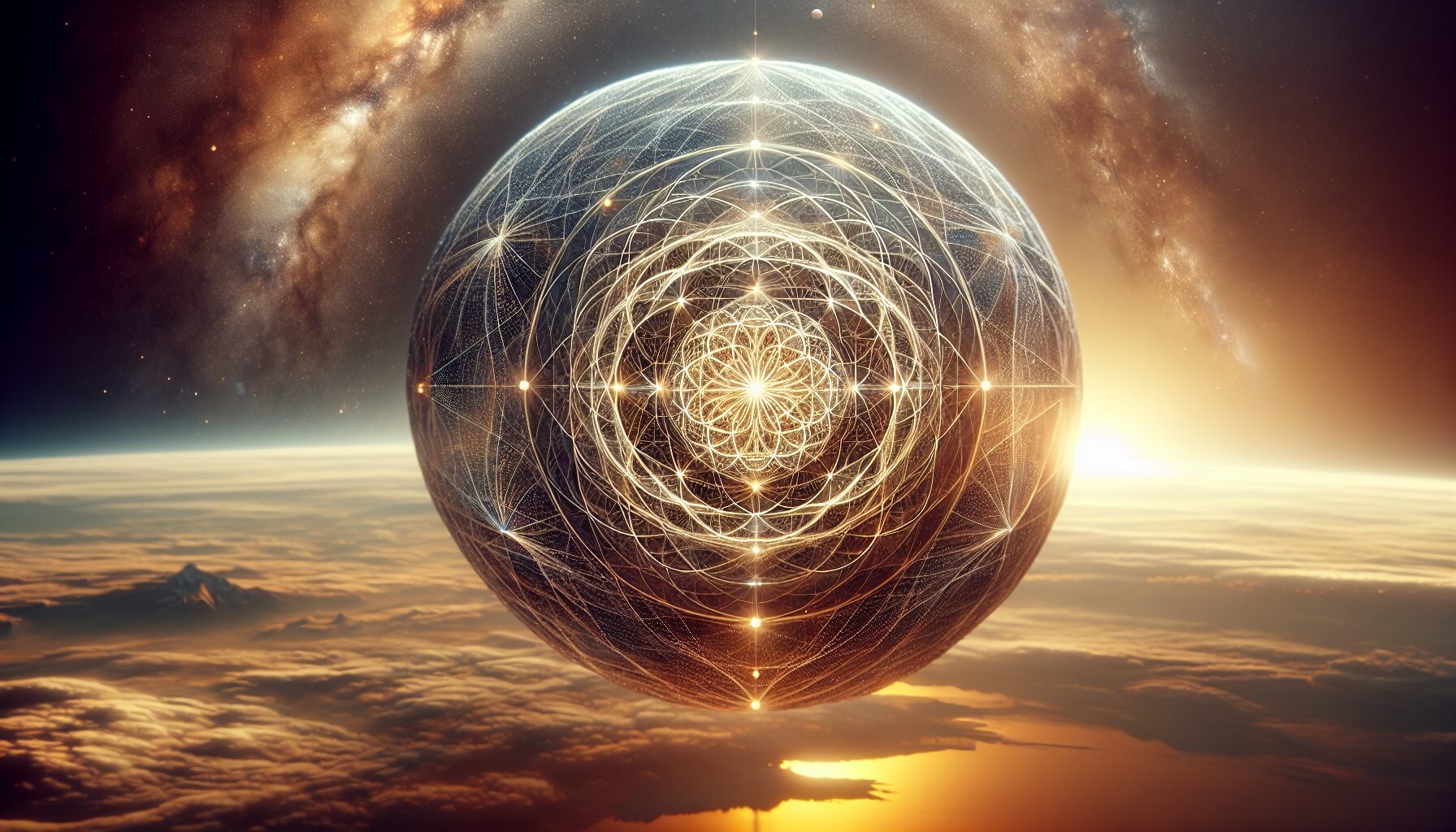
Throughout history, various cultures and spiritual traditions have revered geometry as a profound representation of the divine. The concept of sacred geometry suggests that geometrical figures, patterns, and shapes hold intrinsic value and meaning representing the underpinnings of all existence. This provides a symbolic map to the interconnectedness of life, spirituality, and the universe.
The Origin and Significance of Sacred Geometry
Sacred geometry is not merely about studying shapes and their mathematical properties; it’s about recognizing the sacred architectural blueprints that permeate our world. These shapes can be found in architecture, art, and nature—from the spiral of a galaxy to the nautilus shell and patterns in flowers. Each exemplifies an underlying order—a divine pattern that many believe is the universe’s signature.
“Mathematics is the language in which God has written the universe.” – Galileo Galilei
Key Elements of Sacred Geometry
Several key shapes and patterns are central to the study of sacred geometry. Here are a few with immense significance:
- The Flower of Life: A symbol consisting of multiple evenly-spaced overlapping circles, forming a flower-like pattern. It represents the cycle of creation and is said to contain patterns of all existence.
- The Golden Ratio (Phi): A mathematical ratio, approximately 1.618, that is often encountered in the design of life forms and can be found in structures like the Parthenon and the pyramids of Egypt.
- The Fibonacci Sequence: A sequence of numbers where each number is the sum of the two preceding ones. It is closely related to the Golden Ratio and is prevalent in nature, such as the arrangement of leaves around a stem.
- Metatron’s Cube: Composed of 13 circles, it symbolizes the building blocks of the universe and includes shapes like the Platonic Solids, which are considered the foundation of physical reality.
The Interrelation of Sacred Geometry with Spiritual Traditions
Sacred geometry often finds expression across different religious and spiritual traditions:
- Christianity: The Vesica Piscis, an almond-shaped figure of two intersecting circles, often represents the interface between the spiritual and the material. It can be seen commonly as a symbol of the Holy Trinity in Christian iconography.
- Hinduism: Mandalas are intricate patterns that facilitate meditation and spiritual insight and are believed to represent the cosmos metaphysically or symbolically.
- Islamic Art: Complex geometric patterns are used extensively in Islamic art as it is considered a reflection of the divine and transcendent nature of creation.
Sacred Geometry in Nature
Nature is a testament to the pervasiveness of these divine patterns. For example:
- The spiral pattern in shells, galaxies, and even hurricanes follows the Fibonacci sequence.
- The hexagonal structures of honeycombs demonstrate efficiency and strength, representing nature’s tendency to form patterns optimally.
- The leaf arrangement around stems, or phyllotaxis, often follows the Fibonacci sequence, which optimizes light capture.
Sacred Geometry in Modern Science and Design
Modern science continues to uncover the presence of sacred geometry in various aspects of life and technology:
“Geometry is the archetype of the beauty of the world.” – Johannes Kepler
- Architects incorporate these principles to create harmonious and aesthetically pleasing structures, as inspired by the historical wonders like the Notre Dame.
- Artists, such as Leonardo da Vinci, employed principles of sacred geometry to create masterpieces, like the Vitruvian Man, exemplifying the balance of the human body mirroring the universe.
- In science, DNA double helix structures and crystal patterns in mineralogy highlight geometry’s role at the minute levels of reality.
Conclusion
The sacred geometry of being is more than an artistic or philosophical curiosity; it is a unifying language of the cosmos that bridges the gaps between science, art, spirituality, and nature. By engaging with sacred geometry, one is invited to journey inward, exploring the divine architecture of existence. It is a testament to humanity’s enduring quest to understand the vast, interconnected universe around us and within us. Embracing this mystical unity can transform our perception of life, illuminating the divine pattern within all things.
As we continue to delve deeper into the secrets of sacred geometry, we uncover not only the mysteries of the universe but also the pathways to understanding our place within it.