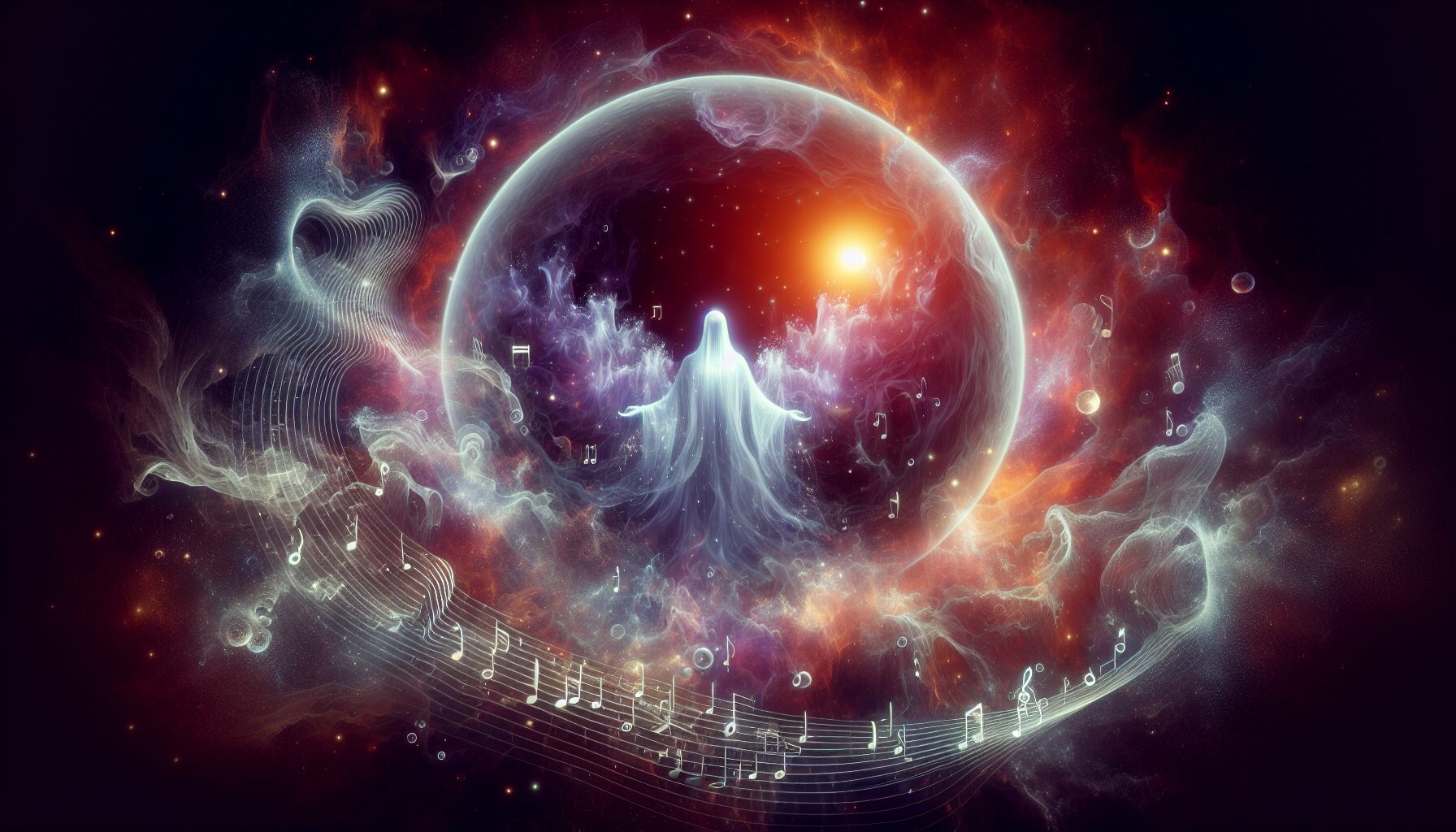
Since ancient times, philosophers and dreamers have contemplated the harmonious relationship between the cosmos and human existence. This celestial harmony famously referred to as the “Music of the Spheres,” paints a picture of an ordered universe where celestial bodies create a symphony of divine proportions. As we delve into this ancient concept, we explore its philosophical meanings and its influence on music and the human soul.
The Origin of the Music of the Spheres
The notion of the “Music of the Spheres” originates from the ancient Greek philosopher Pythagoras. He proposed that the cosmos chanted a perfect symphony, imperceptible to the human ear but integral to the balance of the universe. This resonant harmony was believed to mirror ideal mathematical relationships.
“There is geometry in the humming of the strings, there is music in the spacing of the spheres.” – Pythagoras
Pythagoreanism suggested that each planet, including the Sun and the Moon, was embedded in its own crystalline sphere and that the movement of these spheres produced a universal harmony. Though physically inaudible, this cosmic music influenced the universe’s order and harmony.
The Philosophical Implications
For thinkers like Plato and Aristotle, the Music of the Spheres encompassed more than just cosmic speculation; it offered a profound philosophical framework. Plato touched upon this theme in his dialogue Timaeus, portraying a cosmos created through harmonious proportions.
In his works, Aristotle contemplated how this cosmic music could affect ethics and governance, suggesting a correlation between universal harmony and societal order. The idea was continually revisited by subsequent philosophers and persisted into the Renaissance, with figures like Kepler reviving it alongside the scientific revolution.
The Influence on Music
The impact of the Music of the Spheres spans beyond philosophy into the realm of music itself. Composers throughout history have drawn inspiration from this celestial symphony.
- Johann Sebastian Bach: His intricate compositions, particularly The Well-Tempered Clavier, are often seen as attempts to mirror the mathematical and harmonious properties attributed to the spheres.
- Gustav Holst: In the 20th century, Holst’s orchestral suite The Planets is a direct homage to the celestial bodies, albeit with a more astrological than mathematical lean.
The Music of the Spheres also inspired modern genres such as ambient music, permeating into soundscapes designed to evoke cosmic and ethereal emotions, offering listeners a sense of the universe’s vastness and mystery.
Modern Interpretations and Science
While the strictly Pythagorean view was long debunked by science, interest in cosmic harmony remains vibrant. Contemporary scientists and musicians seek ways to transform the data from celestial bodies into sound. Projects like [NASA’s Music with Universe](https://science.nasa.gov/science-news/science-at-nasa/2008/30oct_sonification) utilize sonification to interpret astronomical data as music.
This modern interpretation, while scientifically grounded, keeps the spirit of the ancient concept alive by making the cosmos’ silent data audible, entrancing modern audiences with a new form of the cosmic symphony.
The Soul’s Resonance
Contemplating the Music of the Spheres leads us to consider how it might resonate with the human soul. Carl Jung and others in psychology reminisce on this ethereal music as a metaphor for the unconscious mind—a vast, uncharted territory filled with unknown harmonies and meanings.
The symbiosis between the universe’s harmony and our internal states is a theme that remains potent, driving both introspection and creativity. As Shakespeare eloquently stated:
“There’s not the smallest orb which thou behold’st but in his motion like an angel sings.” – William Shakespeare, The Merchant of Venice
It symbolizes a universal connection—a dance of harmony that sparks inspiration and reflects the boundless intricacies of the human spirit.
Conclusion
The Music of the Spheres, though invisible and inaudible, has left an indelible impact on human history. From Pythagoras’ theories to modern interpretations, it invites us to seek a deeper connection between the cosmos and our own inner worlds. Regardless of its literal existence, the concept remains a powerful metaphor for the pursuit of harmony, understanding, and unity within both ourselves and the universe.