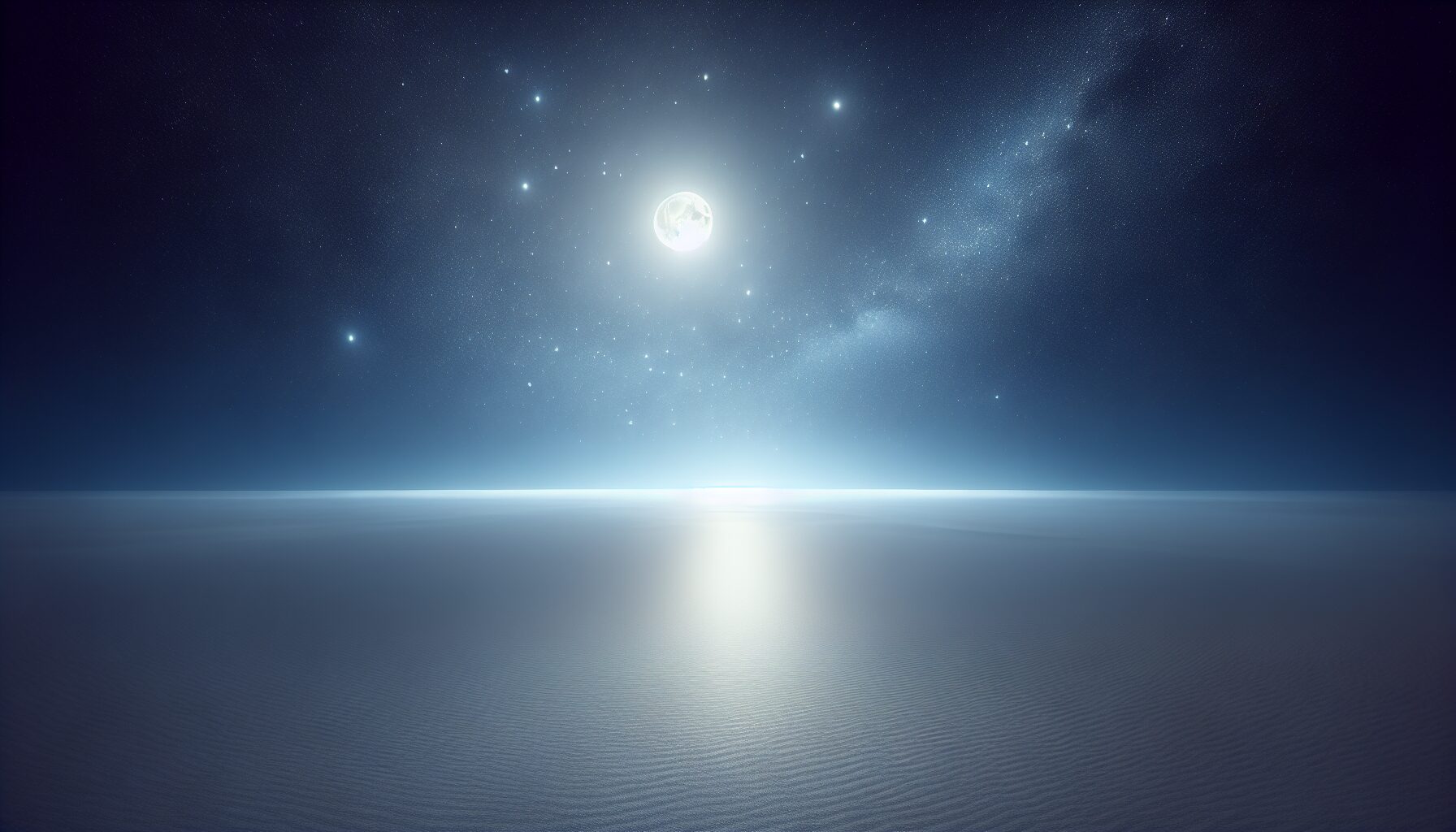
Every night, as the clock nears midnight, a solitary observer hangs silently in the sky, casting its gentle glow over the world below. The moon, with its serene luminosity, has stood as an eternal witness to Earth’s ebbs and flows for eons. Often seen as a symbol of mystery and tranquility, it remains a steadfast companion in the ever-changing tapestry of the night sky.
“For most of history, man has had to fight nature to survive; in this century, he is beginning to realize that, in order to survive, he must protect it.” – Jacques-Yves Cousteau
The moon has been the muse for countless artists, poets, and dreamers throughout history. Its presence is both calming and enigmatic, a silent guardian that inspires reflection and wonder. In literature and folklore, the moon is often associated with femininity, intuition, and the subconscious — a celestial mirror reflecting the depths of the human soul.
The Science Behind the Glow
Scientifically, the moon’s glow is not its own. It reflects the sunlight that reaches its surface, a testament to the interconnectedness of celestial bodies. This reflection is a reminder of how different forces in the universe interact in harmony to create what we perceive as beauty and light.
- Distance: The moon is about 238,855 miles away from Earth, a distance that seems both close and immeasurable.
- Phases: Its phases — from crescent to full and back to new — symbolize the cycles of life and the passage of time.
- Gravity: Its gravitational pull affects the tides on Earth, showcasing its invisible yet profound influence on our planet.
These scientific aspects only add to the moon’s allure, further elevating its status as a symbol of the mystical and the unknown. For millennia, people have looked up at the moon and marveled at its stark beauty and silent power.
A Cultural Tapestry
The moon’s cultural impact is as varied as the phases it cycles through each month. In ancient Egypt, the moon was embodied by the god Thoth, often depicted as a man with the head of an ibis. In other cultures, it is personified in legends of Chang’e, the Chinese moon goddess who lives on its surface with a jade rabbit.
Across the world, the moon has been intrinsic to the calendars of ancient civilizations, guiding planting and harvest seasons. It has influenced art and architecture, from the lunar calendars of the Mayans to the intricate carvings on the temples of Angkor Wat that align with the lunar cycle. The moon continues to influence modern culture, reigning as a muse in music, art, and literature.
Modern Explorations
In the 20th century, the moon became the focal point of humanity’s aspirations to reach beyond the confines of Earth. The NASA Apollo missions transformed this celestial body from an emblem of distant dreams into an attainable frontier.
“That’s one small step for man, one giant leap for mankind.” – Neil Armstrong
The words spoken by Neil Armstrong as he set foot on the moon’s surface heralded a new era of exploration, one where the moon served not only as a spiritual symbol but also as a tangible goal. It resonated with millions across the globe, uniting humanity with a shared sense of accomplishment and potential.
The Moon in the Age of Technology
Today, the fascination with the moon continues as missions are set in place to return to and study its surface further. Projects aim to establish bases on the moon, potentially using it as a launchpad for future missions to Mars and beyond. This renewed interest underscores the moon’s enduring presence at the intersection of science and imagination.
Meanwhile, in the digital age, the moon’s symbolism evolves yet again. It becomes a beacon of nostalgia and hope in a world increasingly driven by technology. Art and culture continue to draw upon its mystique, as artists from diverse mediums reinterpret its image to fit modern narratives.
The moon, in its eternal patience, watches over these changes. Its glow, cascading over oceans and mountains, cities and plains, reminds us of the beauty in calm and the importance of reflection. As long as the night endures, the moon will be there — our eternal witness — guiding us through the cycle of life, ever brilliant against the backdrop of the infinite sky.