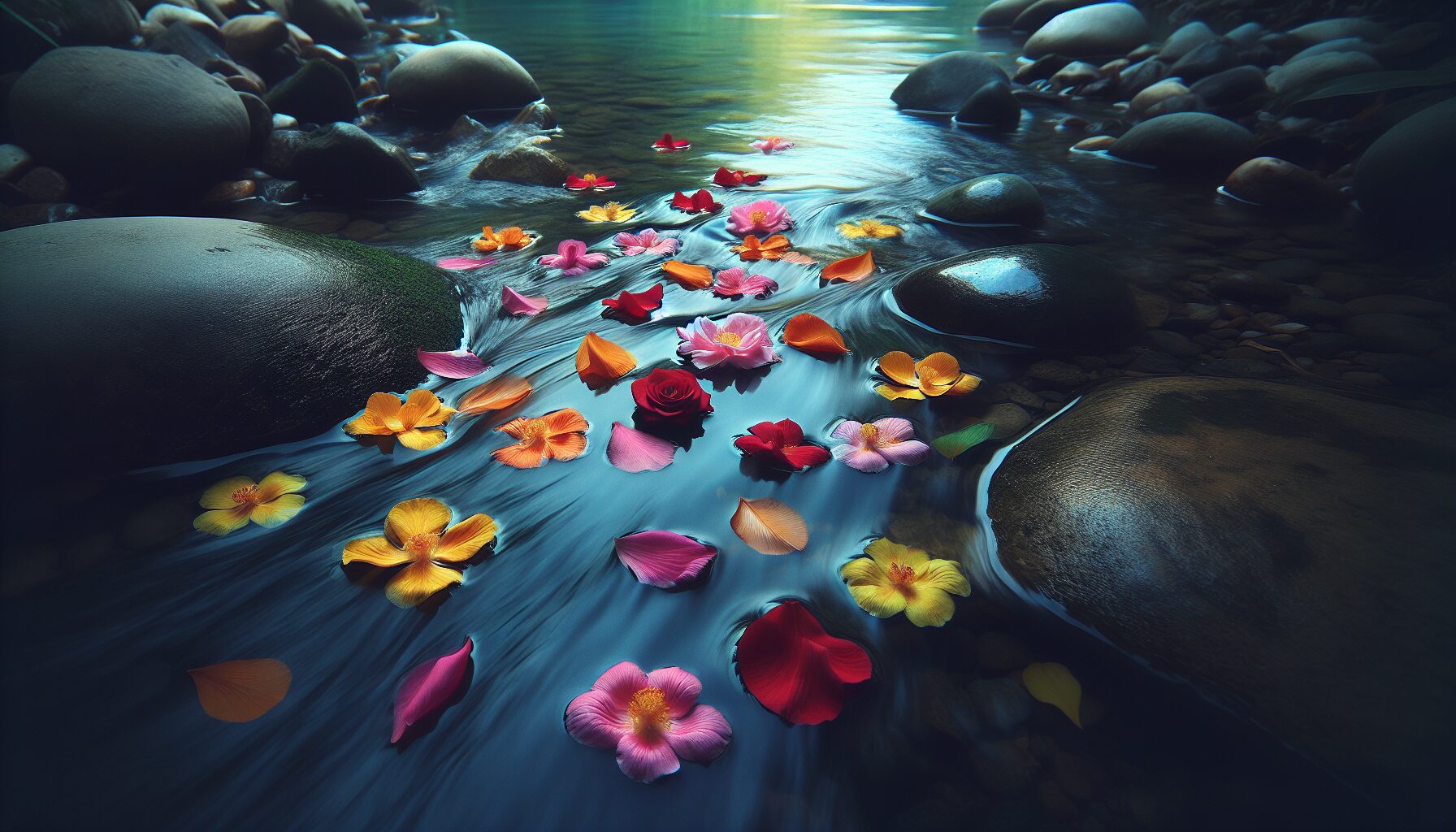
The fleeting beauty of petals gently drifting down a stream serves as a poignant reminder of the impermanence that permeates all of life. This image captures the delicate balance between beauty and its transient nature, urging us to find meaning and peace within the cycle of change.
The Symbolism of Petals in Water
The imagery of petals on a stream has been referenced in various spiritual and philosophical teachings, where it often symbolizes the transient beauty of life. In Zen Buddhism, for instance, the ephemerality of cherry blossoms, or sakura, is celebrated during Hanami festivals as a powerful metaphor for the temporal nature of existence.
“The cherry blossom represents the fragility and beauty of life. It’s a reminder that life is almost overwhelmingly beautiful but that it is also tragically short.” — Homaro Cantu
Embracing Impermanence
Impermanence, known as Anicca in the Pali language of early Buddhist scriptures, is one of the foundational concepts of Buddhism. Acknowledging that all forms and experiences are transitory can dissolve fears rooted in loss and change, opening the door to true liberation.
- Mindfulness: Practicing attentiveness allows one to observe the rise and fall of emotions, thoughts, and sensory experiences without attachment or aversion.
- Non-Attachment: Understanding that we cannot cling to moments provides a freedom that enables deeper connection and appreciation of the present.
- Acceptance: Welcoming change with grace and courage helps cultivate inner peace.
According to the Buddha’s teachings, recognizing the nature of impermanence can reduce suffering, as we learn to accept that change is an inherent component of existence.
Finding Beauty in Transience
The concept of finding beauty within impermanence is not unique to Buddhism. In the Japanese philosophy of Wabi-Sabi, imperfection and the passage of time are celebrated. Through this lens, the fall of petals is seen as more than just an ending; it’s a beautiful moment of transformation.
Author Leonard Koren, in his book Wabi-Sabi: for Artists, Designers, Poets & Philosophers, describes this worldview as: “Wabi-sabi suggests that beauty is a dynamic event that occurs between you and something else. Beauty can spontaneously occur at any moment given the proper circumstances, context, or point of view.”
Learning from Nature
Just as the petals are caught in the flow of the stream, so too are we all participants in the river of time, moving from one moment to the next. Nature can teach us profound lessons about adaptation and resilience through its constant cycles.
- Resilience: From decay comes the nourishment for new growth, illustrating the cyclical nature of life.
- Patience: Nature works in its own time, reminding us to align with its slow, intentional pace rather than rushing.
- Gratitude: When we see beauty even in leaving and loss, our appreciation is deepened for each fleeting moment.
Practicing Awareness
Engage in mindful practices to cultivate awareness of impermanence:
- Meditation: Allocate time to sit in silence, observing breath, sounds, and the workings of your mind.
- Journaling: Reflect on the changes you notice in nature and within your personal experience over time.
- Walking in Nature: Participate in mindful walking, focusing on each step and the world around you.
These practices reveal the interconnectedness and constant flux of life, offering solace and comprehension amidst the world’s chaos.
A Return to the Stream
The gentle descent of petals onto the stream, their temporary ride upon its surface, and their eventual sinking beneath the water is eloquent poetry in motion. This eternal movement invites contemplation of our place within it, encouraging us to cherish each beautiful, impermanent moment.
“Life is a dance. Mindfulness is witnessing that dance.” — Amit Ray
As we observe the petals drift by, let us remember that beauty lies not in permanence, but in our ability to see the transient nature of all things as a source of inspiration and reflection.