Cosmic Play of Creation: Universe’s Joyful Act of Making
The universe, in all its vastness and complexity, is often viewed as a stage for the cosmic play of creation. From the intricate dance of subatomic particles to the majestic swirl of galaxies, creation manifests itself in myriad forms, each exhibiting a joyful act of making — a testament to the ceaseless energy and vibrancy of the cosmos.
The Dawn of the Universe: A Melodic Big Bang
It all began approximately 13.8 billion years ago with the Big Bang, a moment of unimaginable energy and unity. As theoretical physicist Michio Kaku remarked, “The universe burst into something from absolutely nothing—zero, nada. And as it got bigger, it became filled with even more stuff that came from absolutely nowhere.”
This initial explosion wasn’t just a chaotic efflux of matter and energy, but rather a symphonic outburst that laid the groundwork for all forms of matter and energy we observe today. From the microscopic to the macroscopic, the universe’s origin is the quintessential joyful act of creation — a vital testament to its inherent creativity.
“The more we understand the universe, the more it seems less and less necessary to know our place in it.” – Neil deGrasse Tyson
Galactic Ballet: The Artistry of Cosmic Structures
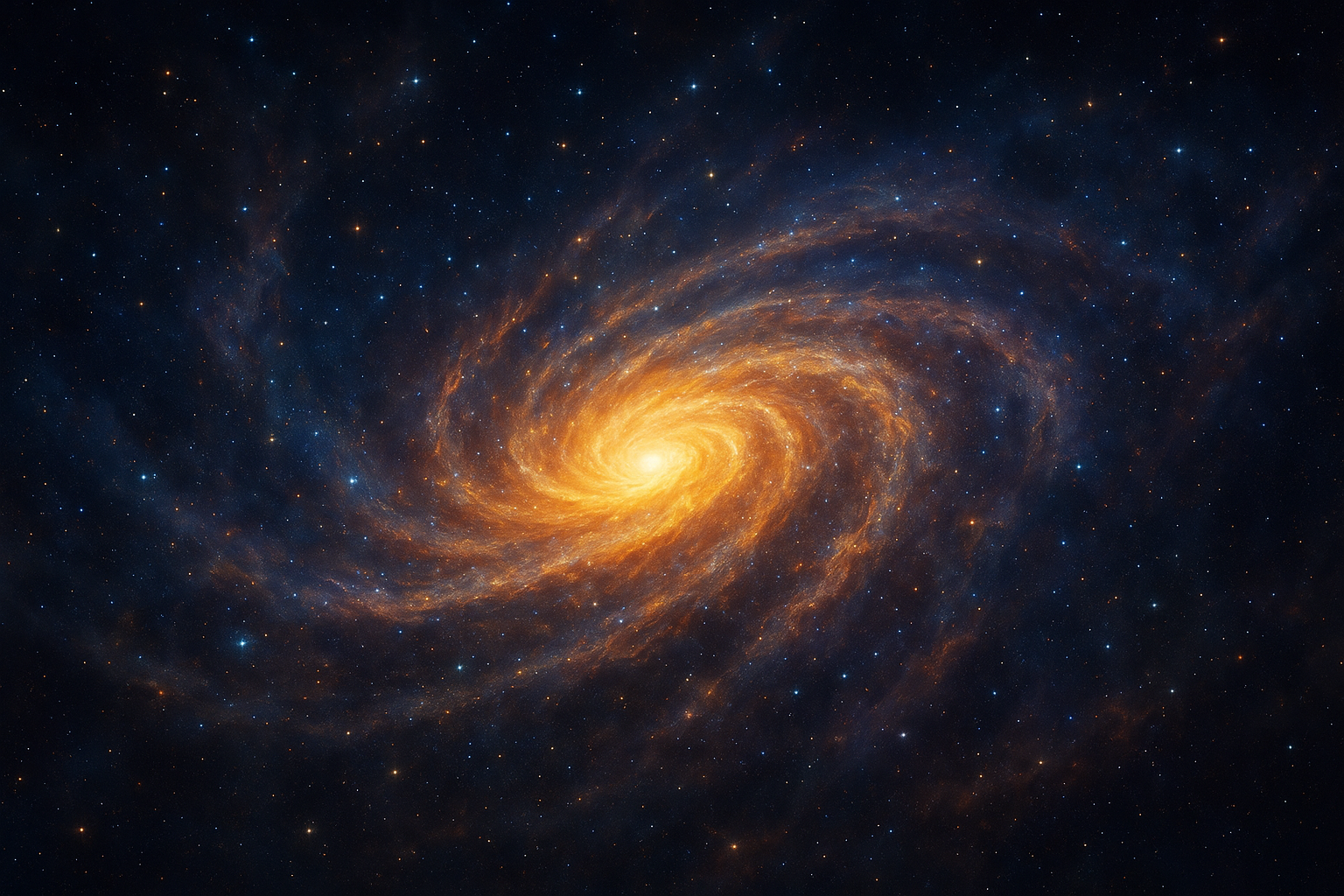
The universe, in its grandeur, orchestrates a complex ballet of galaxies. Spirals, ellipticals, and irregulars — each galaxy is a masterpiece of cosmic creation, housing billions of stars and untold planets. The graceful spirals of the Milky Way invite us to ponder the cosmic forces that sustain such elegance.
- Spiral Galaxies: Our celestial home, the Milky Way, falls into this category. These galaxies are rich in gas and dust, conducive to star formation and the birth of solar systems. Their arms swirl outward, creating a hypnotic dance across the night sky.
- Elliptical Galaxies: Often older and less vibrant, these galaxies possess a more oblong shape. Their stars orbit in random directions, like a whirlwind giving birth to new forms.
- Irregular Galaxies: Defying categories, these galaxies exhibit shapes as various as the universe itself, an embodiment of improvisation within the cosmic symphony.
The Quantum Realm: A Dance of Particles
The universe’s theatricality is not confined to the grand scale; it makes its presence felt in the quantum realm as well. Known for its bizarre and counterintuitive properties, quantum mechanics reveals a world where particles appear and disappear, entangled in a mysterious dance that defies classical logic.
In Richard Feynman’s words, “I think I can safely say that nobody understands quantum mechanics.” This enigmatic nature contributes to its wonder, offering a stage for continual creation and innovation at the subatomic level. From electrons to quarks, the quantum level is a realm of potential and possibility, embodying the universe’s playful creativity.
Stars: Factories of Creation
The stars, with their life cycles resembling that of sentient beings, burn through their nuclear fuels with a purpose — to enrich the universe. Stars are not only radiant beacons in the night but also cosmic forges creating new elements.
- Nuclear Fusion: At the core of a star, hydrogen atoms fuse to form helium in a process that releases vast amounts of energy, illuminating the cosmos.
- Supernova Explosions: The universe’s fireworks. In their death throes, massive stars explode, scattering heavy elements like oxygen, carbon, and iron across space — seeds for new stars, planets, and potentially, life.
This cycle of death and rebirth is central to the universe’s ethos of joyous creation, where end signals a new beginning.
The Birth of Star Systems and Planets
Amidst the cosmic dust clouds, stellar nurseries give rise to star systems, complete with planets, moons, and comets. These cosmic embryos offer fertile ground for life’s possibilities, driven by gravitational forces and the remnants of bygone stars.
Carl Sagan eloquently stated, “The cosmos is within us. We are made of star stuff.” Every atom of our being, forged in the heart of a collapsing star, binds us to the universe’s ongoing narrative of creation.
Life on Earth: A Testament to Cosmic Creativity
Our planet, the blue jewel amid the vast emptiness of space, showcases life’s resilience and adaptability — a microcosm of the universe’s inventive spirit. From the deep-sea hydrothermal vents, where life questions its boundaries, to the infinite intelligence modeled in the human brain, Earth testifies to creation’s joy.
- Evolution: The ultimate creative process, a grand theater of survival, adaptation, and diversity.
- Cultural Advances: Humanity’s art, science, and philosophy mirror the universe’s capacity for creativity and change, forging new paths of understanding.
Conclusion: The Universe as a Creative Force
In contemplating the cosmic play of creation, one encounters a reality that is continuously unfolding, made not from a script, but from the infinite possibilities and creative impulses inherent in the very fabric of the cosmos.
“Look up at the stars and not down at your feet. Try to make sense of what you see, and wonder about what makes the universe exist.” – Stephen Hawking
The universe is not just a backdrop for existence; it is a dynamic player that continues to evoke a sense of wonder and joy through its acts of creation. Every element, process, and phenomenon contributes to an ongoing narrative — the joyful storytelling of the universe at play.
As we stand gazing at the night sky, we find ourselves not mere spectators but participants in this cosmic play — an eternal celebration of creation.