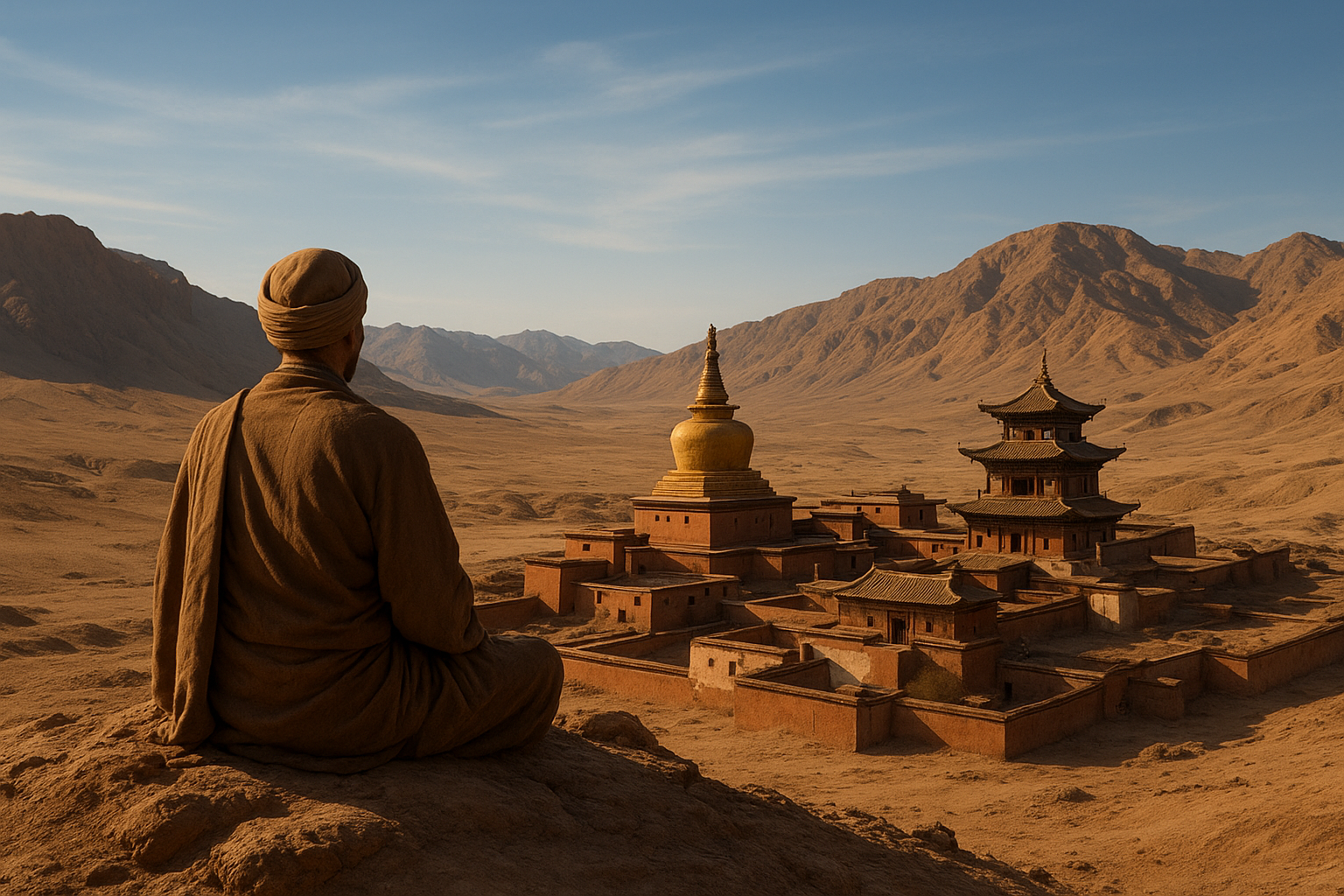
When the Desert Meets the Monastery: Abrahamic Longing and Buddhist Discipline in Dialogue
In the vast expanse of spiritual landscapes, there lies an intriguing intersection between the Abrahamic traditions and Buddhism. These seemingly divergent pathways meet at an unexpected crossroads where the desire for divine connection and profound discipline converge. This spiritual dialogue offers an enriching exploration of faith, practice, and the human quest for meaning.
Pilgrimage and Asceticism
The Abrahamic traditions—Judaism, Christianity, and Islam—are rich with narratives of pilgrimage and a profound longing for the divine. From the arduous journey of Hajj to the stories of biblical prophets wandering the desert, there is a persistent theme of seeking and yearning. At its core, this is a journey both external and internal, mirroring the path of Buddhist ascetics who retreat into silence to find enlightenment.
“The desert was seen as the natural habitat of the prophet, and a place for reflection, away from the distractions of the world,” writes Karen Armstrong in her book “Muhammad: A Prophet for Our Time”. This notion resonates deeply with the monastic traditions in Buddhism, where isolation serves as a gateway to self-discovery.
The Hermit’s Challenge
Both traditions emphasize renunciation. In Christianity, the desert fathers and mothers retreated into the wilderness, resembling the solitary monks of Buddhism’s forest tradition. These ascetics exemplify the spiritual discipline of both faiths. They sought to dispel distractions, silence the mind, and cultivate a profound inner acceptance of spiritual truths.
The challenge faced by these hermits is aptly summarized by Thomas Merton, who noted in his writing: “To deliver oneself up, to throw oneself headlong into the infinite mercy of God,” speaks not only of a Christian experience but echoes the sentiments found in Buddhist samadhi (concentration).
Community and Solitude
While the Abrahamic faiths often emphasize community worship, they also develop a rich tradition of solitude and prayer. Islam’s mystics—Sufis—and Christian monastics both pursue the divine through rhythms of communal harmony and solitary reflection, crafting a life that mirrors the balance seen in Buddhist monasteries.
- Judaism’s scholars: Often retreat into focused study to understand and connect with divine wisdom.
- Christian Monastics: Engage in silence and contemplative prayer, embracing solitude as a path to communion with God.
- Sufi Practitioners: Merge music and movement to bridge the temporal with the eternal.
Likewise, Buddhist monks navigate the dichotomy between the solitary pursuit of nirvana and their role within sangha, the Buddhist community.
Mindfulness and Prayer
The practices of mindfulness in Buddhism and prayer in the Abrahamic traditions offer another fascinating parallel. Mindfulness seeks to anchor the practitioner in the present, cultivating awareness and acceptance of the moment. This echoes the Jewish tradition of kavanah (intention), the Christian practice of lectio divina, and the focused meditation in Islam’s dhikr.
Thich Nhat Hanh, a renowned Buddhist monk, often spoke about the intersection of mindfulness and prayer, stating, “When you understand interbeing, you’ll do what you can to make life beautiful for yourself and others.” This sentiment is a bridge that connects human experiences across these faiths.
A Dialogue Continued
Such intersections of spiritual longing and disciplined practice illustrate a commonality that transcends doctrinal differences. They foster dialogue that enriches and expands understanding, demonstrating that the core aspirations of humanity—searching for peace, understanding, and connection—are universal.
In a world increasingly defined by division, the serene dialogue between the desert and the monastery stands as a testament to the potential for harmony through shared spiritual endeavor. As followers of different paths continue to explore this dialogue, they illuminate the possibility of finding solidarity amid diversity.
Indeed, when the desert meets the monastery, there’s more than just a convergence of religious thought; it’s an opportunity for profound personal and collective transformation, inviting all seekers to partake in the timeless journey towards truth and enlightenment.