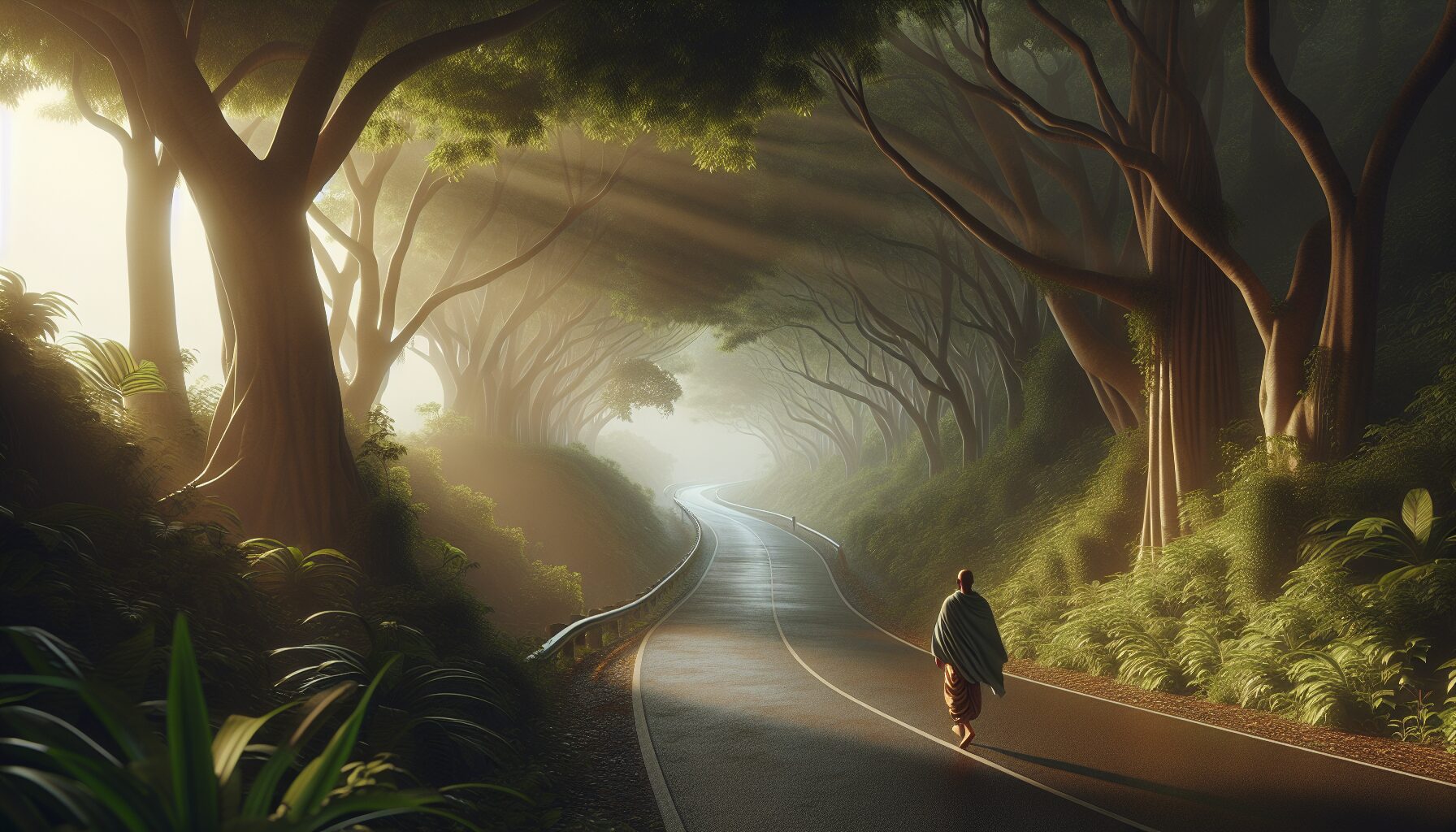
The Hermit’s Road — Solitude as Communion
In a world that celebrates connectivity, the hermit’s path might seem like a solitary journey against the grain.
Yet, for millennia, the figure of the hermit has fascinated and inspired people across cultures. The allure is rooted
in the paradox of finding communion in solitude—a sacred engagement with the self, and perhaps, with something greater.
“The monotony and solitude of a quiet life stimulates the creative mind.” — Albert Einstein
The Historical Lure of Hermitism
From the deserts of Egypt to the mountains of Tibet, hermits have pursued lives of solitude for different reasons:
religious devotion, philosophical inquiry, or a simple rejection of societal norms. Despite diverse backgrounds,
they share a common pursuit—a deeper understanding of life’s essence through isolation.
- Desert Fathers: In the 3rd century, a group of Christian hermits retreated into the deserts
of Egypt, seeking spiritual enlightenment away from the comforts and distractions of society. - Taoist Hermits: Taoist sages in ancient China often withdrew to remote mountains to refine their
spiritual practices and connect with the fundamental rhythms of nature. - Tibetan Recluses: Tibetan Buddhism has a rich tradition of monastics and lay practitioners
adopting solitary retreats to deepen their meditative practices.
The Spiritual Dimension of Solitude
Hermits step away from the communal aspects of religion to foster a personal bond with their beliefs. In this process,
solitude serves not as an escape but as a space for profound spiritual introspection. As the Buddhist monk
Thich Nhat Hanh noted, “The more you focus
on your breathing, the more you encounter your body and its relationship with the earth.”
Solitude becomes sacramental, transforming the isolated landscape into a canvas for communion with the divine. It
allows for an inward pilgrimage, unearthing wisdom from within and attuning individuals to the silent voice of the cosmos.
The Modern Implications of Solitary Practice
Contemporary society often equates solitude with loneliness, a condition to be remedied rather than explored. However,
many modern hermits and practitioners of solitude find that it offers a fertile ground for personal growth and wellbeing.
“In the solitude of the wilderness, we find ourselves. And that is more than enough.” —
John Muir
- Introspection and Mental Clarity: Time spent alone can lead to greater self-awareness and insights,
allowing the individual to reassess life’s priorities without external pressures. - Creative Inspiration: Solitude often breeds creativity, providing an unbroken focus that fuels
novel ideas and innovations. - Emotional Resilience: The practice of facing one’s thoughts and emotions in solitude can lead
to greater emotional stability and a more profound sense of personal autonomy.
A Path Forward with Solitude
As the world becomes increasingly connected, the concept of voluntary solitude challenges us to rethink our
relationships with ourselves and the world around us. Embracing moments of silence and solitude, as brief or as
extended as they may be, can be a powerful act of self-communion and emotional restoration.
Whether one chooses to spend months in a secluded cabin or merely takes a solitary walk in a nearby park,
the journey of the hermit underscores an essential truth: that in seeking solitude, we may find a richer communion
with all of existence.
The hermit’s road is not a path for everyone, but it offers profound insights into the human spirit’s capabilities
when external noise is hushed. In the words of poet
Walt Whitman, “I celebrate myself, and sing myself,” reminding us that solitude can be a profound form of
celebration—a communion where one need not be alone to feel whole.