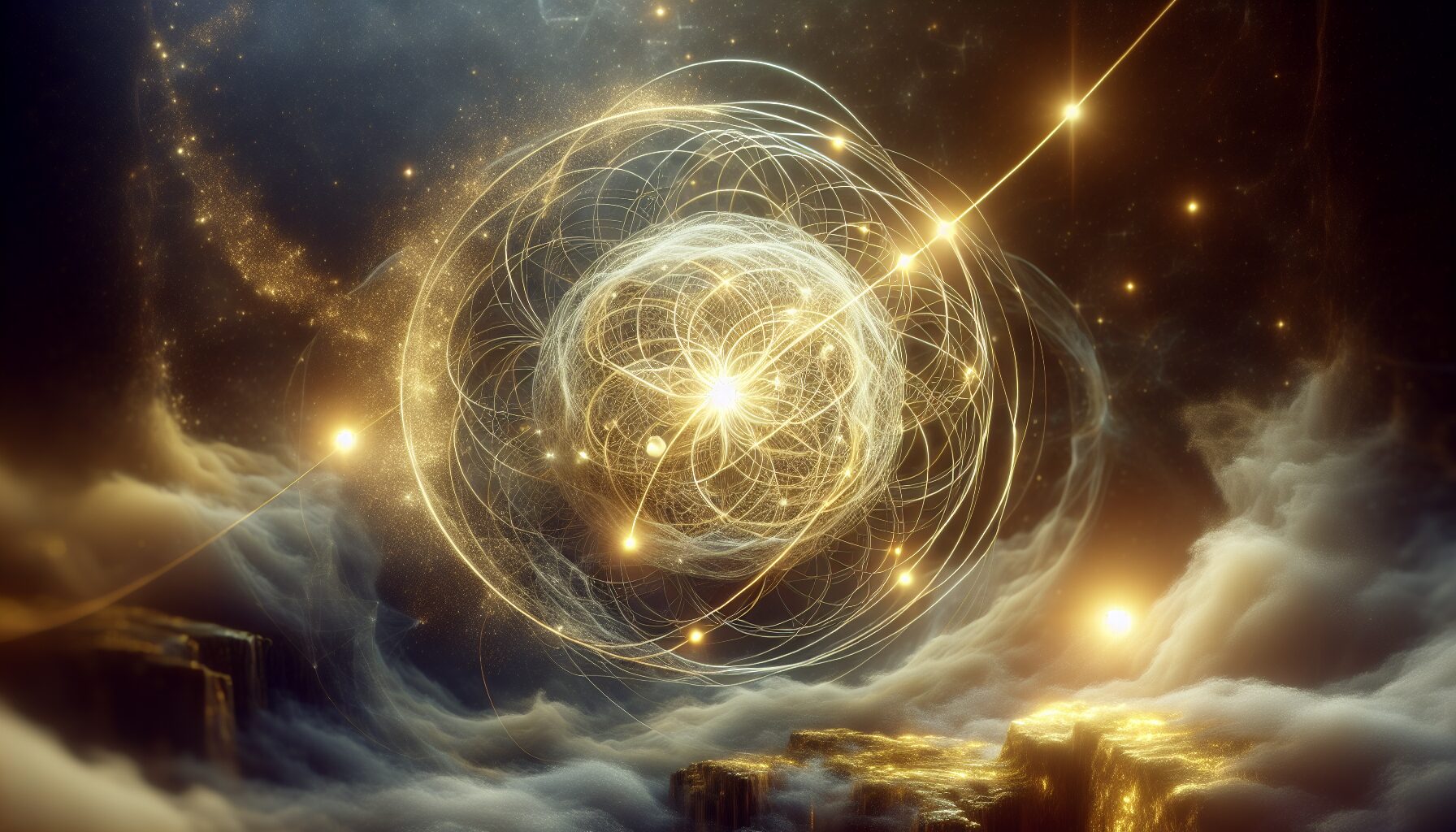
Throughout the tapestry of human history, there has been an enduring fascination with the concept of unity in diversity, the interconnectedness of all existence, and the notion that there lies a golden thread of being that weaves through the fabric of all things. This mystical idea finds expression in various religious, philosophical, and scientific traditions.
Philosophical Foundations
The notion of unity is an ancient one, steeped in philosophical tradition. The pre-Socratic philosopher Heraclitus famously proposed that “All things are one.” The thinkers of ancient Greece, India, and China explored the relationships between the cosmos, humanity, and morality, seeking to understand the universal principles that govern existence.
- Eastern Philosophy: In the East, the concept of unity is deeply embedded in Hinduism and Buddhism. The Hindu Upanishads speak of Brahman, the ultimate reality that pervades everything. Similarly, Buddhism teaches the principle of interdependent origination, asserting that all things arise in dependence on conditions and causes.
- Western Philosophy: The West, too, has its share of thinkers who have pondered the interconnectedness of reality. Baruch Spinoza, a 17th-century Dutch philosopher, proposed a view that everything is part of one single substance, often equated with God or nature.
Religious Insights
Religious traditions worldwide echo the sentiment of a unifying thread that binds everything. Each tradition, in its unique way, articulates a vision of spiritual unity and interconnectedness.
- Christian Mysticism: In Christianity, mystics like Meister Eckhart and St. John of the Cross spoke of the soul’s union with God, emphasizing a direct experience of divine unity. Eckhart’s teachings focus on the concept of detachment and oneness with God, where the soul finds its divine origin.
- Islamic Sufism: Sufism, the mystical branch of Islam, teaches the concept of Tawhid, the oneness of God. This oneness is not just a matter of faith but an experiential realization of God’s presence in all creation. Jalaluddin Rumi, the famous Persian poet, wrote extensively on the theme of mystical unity, as seen in his works that capture the divine dance of all creation with God.
Scientific Perspectives
In recent centuries, scientific discoveries have paralleled mystical insights about unity in nature. Although different in methodology, science and mysticism often arrive at resonant conclusions.
- Quantum Entanglement: The advent of quantum physics in the 20th century revealed phenomena like quantum entanglement, where particles remain connected despite physical distances. Einstein, initially skeptical, famously dubbed this “spooky action at a distance,” yet these findings suggest a deeper level of connection at the subatomic level.
- Ecosystems and Biology: Ecology teaches that life is sustained by intricate networks of interrelations among organisms and their environments. The concept of the biosphere encompassing interconnected ecosystems highlights how the health of the whole is reliant on the balance and interaction of its parts.
The Personal Journey
Beyond philosophical doctrines and scientific theories, the golden thread of being is a personal realization, one that many describe as akin to a spiritual awakening. This journey often leads to a profound sense of peace and responsibility.
“When we have fully allowed ourselves to recognize the interdependence of everything, we’ve begun the first step of realizing that our being is already in unity with all of life.”
— Thich Nhat Hanh
This personal revelation often results in a call to action—towards compassion, environmental stewardship, and a more harmonious coexistence with fellow beings. As the interconnectedness becomes apparent, personal choices often shift towards more sustainable and empathetic living.
Conclusion
The mystical unity that the golden thread of being represents remains both a deeply personal and universally relevant concept. Whether it is found within the meditative practices of Eastern traditions, the spiritual devotion of Western saints, or the cosmological insights of modern science, the message remains clear: we are all parts of an inseparable whole.
As we navigate the complexities of life, this understanding can guide us toward love, unity, and peace, serving as a reminder of the shared destiny that ties all things together in the exquisite tapestry of existence.