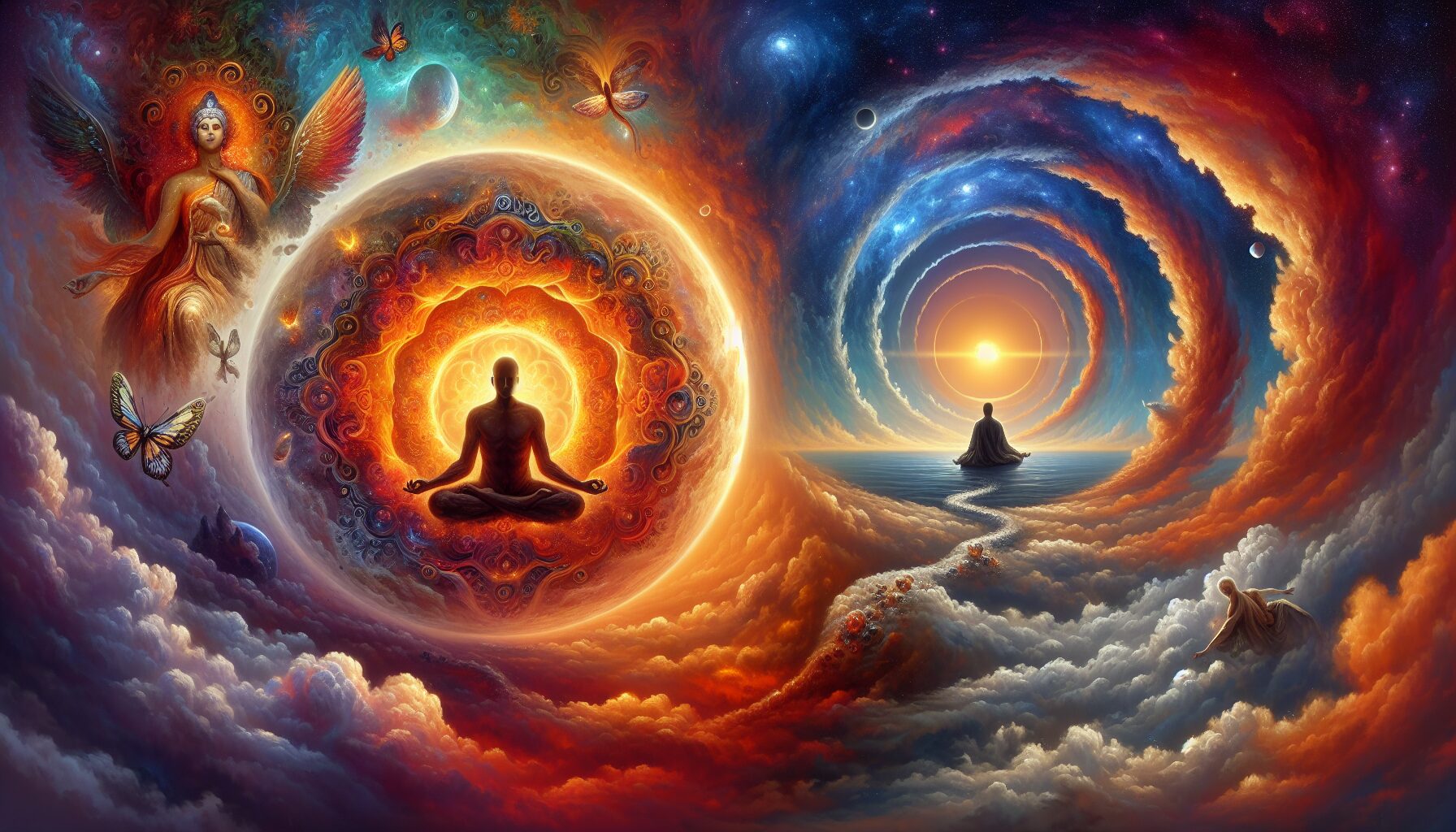
The Circle of Return — Samsara, Nirvana, and the Same Sky
For millennia, the concepts of Samsara and Nirvana have intrigued philosophers, theologians, and seekers of truth. These dual principles, deeply rooted in the spiritual and cultural traditions of the East, paint a picture of the human soul’s journey through existence. This article explores how these ancient ideas resonate with modern individuals and what they reveal about our quest for meaning under the vast and unchanging sky.
Understanding Samsara: The Cycle of Suffering
Samsara, a Sanskrit term, loosely translates to “wandering” or “world.” It represents the endless cycle of birth, life, death, and rebirth that permeates existence due to karma—the sum of one’s actions. This continuous loop symbolizes suffering or Dukkha in Buddhism, much akin to the restlessness many feel in modern life.
“Just as a snake sheds its skin, we must shed our past over and over again.” — Buddha
The cycle of Samsara is not merely metaphysical but mirrors the mundane realities of daily stress, repetitive routines, and cycles of desire and fulfillment that often characterize modern existence. Recognizing this repetitive pattern is the first step toward seeking liberation.
Nirvana: Beyond the Cycle
In stark contrast to Samsara, Nirvana represents liberation from the cyclical nature of suffering. It is a state of ultimate peace and enlightenment where individual desires and suffering cease to exist. The term itself means “to blow out” or extinguish, signifying the quenching of desire and the cessation of suffering.
Nirvana is often misunderstood as nothingness; instead, it is more accurately characterized as a transformation of perception—a profound realization of one’s inherent freedom beyond the attachments and aversions. The Buddha described Nirvana as a “profound, immeasurable, unfathomable peace.”
“There is, monks, an unborn — unbecome — unmade — unfabricated. If there were not this unborn — unbecome — unmade — unfabricated, there would not be the case that emancipation from the born — become — made — fabricated would be discerned.” — [Pāli Canon](https://www.accesstoinsight.org/tipitaka/kn/ud/ud.8.03.than.html), Ud 8.3
The Bridge of the Same Sky
Despite appearing contradictory, the concepts of Samsara and Nirvana both exist under the same sky—the metaphoric framework connecting all lives across time and space. This unity suggests that Samsara and Nirvana are not separate realities but different perspectives of the same existence.
Modern reflections:
- Mindfulness: The practice of mindfulness can bridge the gap between Samsara and Nirvana by encouraging awareness and presence, highlighting the cyclical patterns in one’s life while offering a path to transcend them.
- Non-duality: An essential teaching of many Eastern philosophies is the non-dual nature of reality. This perspective suggests that liberation lies not in escaping life but in embracing it completely, understanding that at their core, Samsara and Nirvana are one.
Lessons for the Modern Seeker
For today’s spiritual seekers, understanding Samsara and Nirvana offers guidance in the quest for peace amid turmoil. Here are some practical insights:
- Awareness of Cycles: By recognizing the repetitive patterns in daily life, one can begin to break free from them, finding small moments of liberation daily.
- Compassion and Understanding: Realizing everyone is entangled in their cycle fosters compassion, reducing the suffering caused by judgment and misunderstanding.
- Integration of Practice: Incorporating mindfulness, meditation, and ethical living into daily routines helps transcend the mundane, leading to deeper states of peace and understanding.
Conclusion
Under the vast, unchanging sky of existence, both Samsara and Nirvana reveal essential truths about the human condition—a cyclical story of suffering and liberation. As ancient as they are poignant, these concepts continue to urge the modern soul toward a deeper understanding and lasting peace.
In this endless circle of return, let us find solace in the same sky that envelops both suffering and liberation, guiding us towards an enlightened state of being.