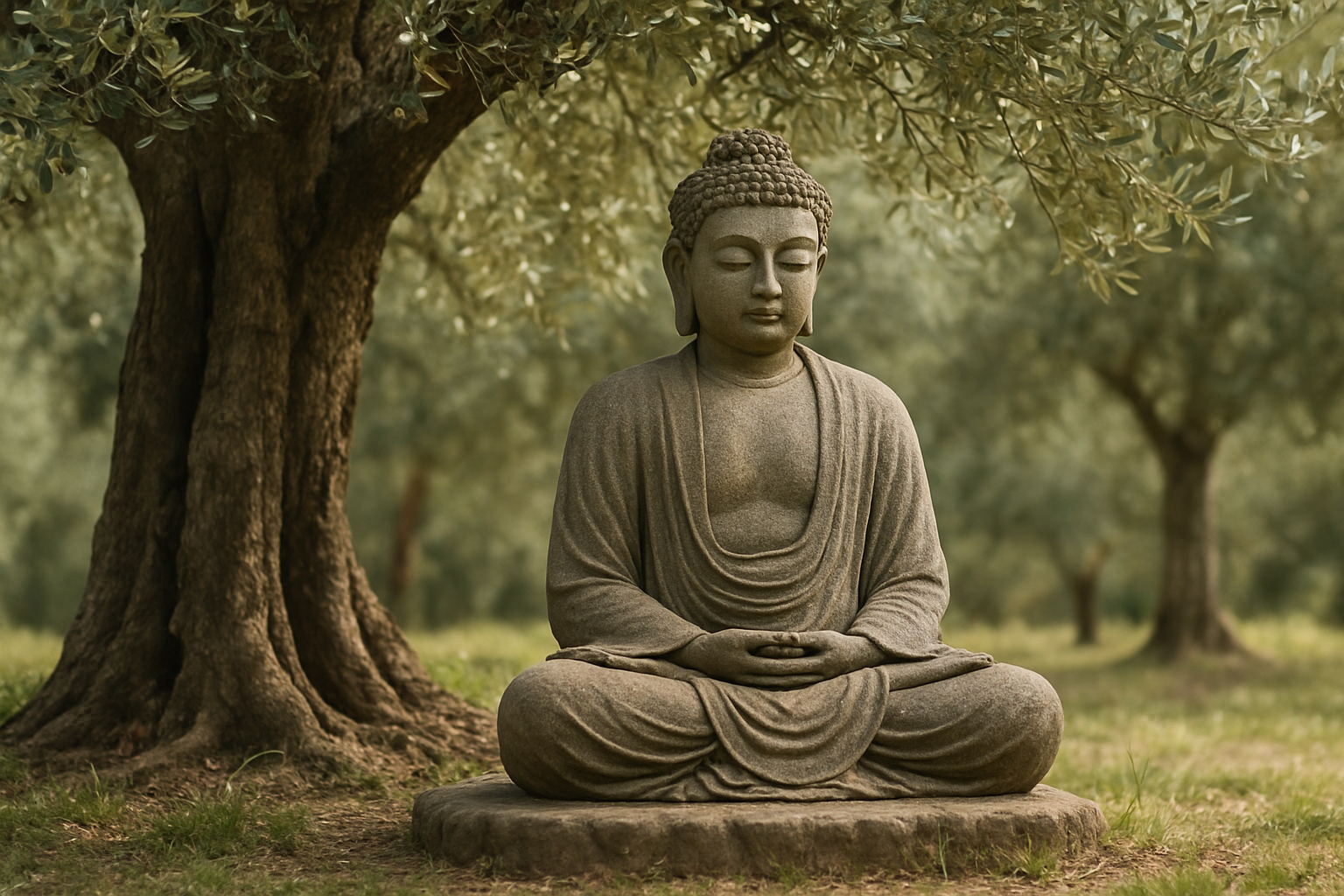
Buddha Under the Olive Tree: Imagining Peace Across Traditions
In an increasingly interconnected world, the quest for peace draws inspiration from various religious and philosophical traditions. One such thought experiment invites us to imagine a serene meeting point where Buddha sits beneath an olive tree, symbolizing the intersection of Eastern and Western philosophies.
The Symbolism of the Olive Tree
The olive tree has long been a symbol of peace, endurance, and friendship in many Western cultures. Deeply rooted in Mediterranean history, it is often associated with stories of resilience and harmony. As the Greek poet Homer once wrote, “The olive tree is always fruitful, both for the oil and the wood that it gives.” This tree, emblematic of the West, provides a poignant location for a cross-cultural dialogue on peace.
Buddhist Teachings on Peace
In contrast, Buddhism provides a rich tapestry of lessons on inner peace and external harmony. Central to its teachings is the notion of Dukkha or suffering, and the path to its cessation through mindfulness and compassion. As the Buddha taught,
“Peace comes from within. Do not seek it without.”
This internal journey towards tranquility can find new dimensions when envisioned under the metaphorical shade of the olive tree.
Imagining a Dialogue
Visualizing a meeting of these two symbols allows for a rich dialogue. What would Buddha, known for his silent yet profound teachings, say to those gathered under the olive tree? Perhaps his focus would be on mindful living, urging individuals to find peace within as the foundation for world peace.
- Meditative Practices: Buddha would likely emphasize the importance of meditation as a means to cultivate an inner peace that radiates outward. This practice is not foreign to the Abrahamic traditions, where contemplative practices, such as prayer and reflection, have similar aims.
- Compassion and Altruism: The emphasis on compassion in Buddhism could find resonance amidst the teachings of figures like Jesus Christ, who advocated for love and forgiveness. Here, the olive’s symbolism of friendship aligns beautifully with the Buddhist teaching of Metta or loving-kindness.
- Interconnectedness: Buddha under the olive tree symbolizes a union of Eastern and Western thought, reminding us of the interconnectedness emphasized in Buddhist teachings. This interconnectedness suggests that peace is not merely a personal pursuit but a collective journey.
Lessons for Today
By envisioning such intersections, one understands that peace transcends cultural and religious boundaries. This imagination can inspire us to cultivate global peace initiatives centered on inclusivity and mutual respect. Mahatma Gandhi, who was profoundly influenced by both Eastern and Western philosophies, famously said,
“In a gentle way, you can shake the world.”
His life serves as a testament to the power of such cross-cultural fusion.
In today’s fragmented world, where divisions are often highlighted, the image of Buddha under an olive tree provides a serene yet potent symbol of unity. It encourages conversations that transcend traditional barriers and foster mutual understanding and respect.
Conclusion: Nurturing the Olive Grove
Imagining Buddha under the olive tree is not just a poetic metaphor; it’s a call to action. It beckons us to nurture an ‘olive grove’ of peace in our communities—spaces where diverse traditions can coexist harmoniously, each bringing its unique wisdom.
In taking inspiration from both the serenity of Buddhist teachings and the enduring peace symbolized by the olive tree, we pave the way for a world that appreciates diversity not as a source of conflict but as an opportunity for profound dialogue and growth.
Let us embrace this vision of cross-cultural synergy, bringing together the intricate patterns of our shared humanity to weave a tapestry of peace that is both resilient and enduring.
For a deeper exploration into how different traditions can contribute to peace, you might find the following resources insightful:
- Access to Insight – An extensive collection of Buddhist teachings.
- Stanford Encyclopedia of Philosophy: Peace – Philosophical perspectives on peace.
- Peace X Peace – A global network of women dedicated to peace building.