Author: divinegong

  • Veil of Light — Seeing the Divine Through the Ordinary

    Veil of Light — Seeing the Divine Through the Ordinary

    Veil of Light: Seeing the Divine Through the Ordinary

    In the midst of the mundane, the divine often lies hidden, waiting to be discovered by those who have the eyes to see and the heart to understand. The concept of seeing the divine through the ordinary is not new; it is deeply rooted in various spiritual traditions that encourage believers to find sacredness in everyday life. This journey of uncovering the divine within the ordinary is like lifting a veil—a veil of light that transforms our perceptions and connects us with the profound presence of the divine.

    The Sacred in the Ordinary

    Throughout history, spiritual leaders and philosophical thinkers have echoed the idea that everyday experiences can be gateways to the divine. As the mystic poet Rumi wrote, “The wound is the place where the Light enters you” (source). Such wisdom suggests that moments of pain, joy, struggle, or serenity are imbued with opportunities for spiritual insight and growth.

    Nature as a Channel to the Divine

    Nature often serves as a powerful veil of light through which the divine reveals itself. The simple act of walking in a forest, listening to the rustle of leaves, or watching a sunrise can become a divine encounter. According to renowned naturalist and philosopher John Muir, “In every walk with nature, one receives far more than he seeks” (source).

    • Meditation in Nature: Engaging in meditative practices while immersed in nature can enhance one’s spiritual experiences. The quiet of nature helps in tuning out the noise of everyday life, allowing for a deeper connection with oneself and the divine.
    • Observing Natural Patterns: By observing the intricate patterns and cycles in nature, one can gain insight into the interconnectedness of all life, a concept emphasized in many spiritual traditions.

    The Divine in Human Interactions

    Human interactions, in their simplicity and complexity, can also become portals to experiencing the divine. Philosopher Martin Buber highlights the “I-Thou” relationship, where true dialogue with another person can transcend the mundane and become a sacred encounter.

    “When two people relate to each other authentically and humanly, God is the electricity that surges between them.” – Martin Buber

    • Acts of Kindness: Simple acts of compassion and empathy can become profound spiritual experiences. Giving and receiving kindness can illuminate the presence of the divine within ourselves and others.
    • Deep Listening: Listening with attentiveness and presence can transform an ordinary conversation into a moment of divine connection.

    Mindfulness in Everyday Activities

    Practicing mindfulness in routine activities such as cooking, cleaning, or even commuting can help unveil the divine in the ordinary. When approached with intention and awareness, these tasks can become meditative practices that ground us in the present moment, revealing their inherent sacredness.

    • Mindful Eating: Taking time to savor each bite, appreciating the food’s origin and preparation, can transform mealtime into a deeply spiritual practice.
    • Mindful Breathing: By focusing on the breath, even in the hustle of daily life, one can find stillness and connect with a deeper sense of peace.

    Finding Sacredness in Art and Creativity

    Art and creativity further demonstrate the divine’s presence in the ordinary. Whether it is music, painting, or dance, artistic expression allows us to glimpse the divine through the veil of human creativity.

    “Art is not what you see, but what you make others see.” – Edgar Degas

    • Artistic Meditation: Engaging in creative endeavors can become a form of meditation, allowing the creator to tap into the divine flow of inspiration.
    • Viewing Art as Worship: Appreciate art and creativity not merely as entertainment, but as acts of worship and divine manifestation.

    Conclusion: Embracing the Divine Adventure

    Seeing the divine through the ordinary transforms the everyday into a spiritual adventure, where each moment is a potential encounter with the sacred. By lifting the veil of light, we open ourselves to experiences rich with meaning and presence, transcending the routine to embrace a life full of spiritual significance.

    As we navigate the ebb and flow of life, let us remember the words of Thich Nhat Hanh, “The miracle is not to walk on water. The miracle is to walk on the green earth, dwelling deeply in the present moment and feeling truly alive” (source). In doing so, we may find that the divine is closer than we ever imagined, present in the very fabric of our everyday lives.

  • Golden Thread of Being — Mystical Unity in All Things

    Golden Thread of Being — Mystical Unity in All Things

    Throughout the tapestry of human history, there has been an enduring fascination with the concept of unity in diversity, the interconnectedness of all existence, and the notion that there lies a golden thread of being that weaves through the fabric of all things. This mystical idea finds expression in various religious, philosophical, and scientific traditions.

    Philosophical Foundations

    The notion of unity is an ancient one, steeped in philosophical tradition. The pre-Socratic philosopher Heraclitus famously proposed that “All things are one.” The thinkers of ancient Greece, India, and China explored the relationships between the cosmos, humanity, and morality, seeking to understand the universal principles that govern existence.

    • Eastern Philosophy: In the East, the concept of unity is deeply embedded in Hinduism and Buddhism. The Hindu Upanishads speak of Brahman, the ultimate reality that pervades everything. Similarly, Buddhism teaches the principle of interdependent origination, asserting that all things arise in dependence on conditions and causes.
    • Western Philosophy: The West, too, has its share of thinkers who have pondered the interconnectedness of reality. Baruch Spinoza, a 17th-century Dutch philosopher, proposed a view that everything is part of one single substance, often equated with God or nature.

    Religious Insights

    Religious traditions worldwide echo the sentiment of a unifying thread that binds everything. Each tradition, in its unique way, articulates a vision of spiritual unity and interconnectedness.

    • Christian Mysticism: In Christianity, mystics like Meister Eckhart and St. John of the Cross spoke of the soul’s union with God, emphasizing a direct experience of divine unity. Eckhart’s teachings focus on the concept of detachment and oneness with God, where the soul finds its divine origin.
    • Islamic Sufism: Sufism, the mystical branch of Islam, teaches the concept of Tawhid, the oneness of God. This oneness is not just a matter of faith but an experiential realization of God’s presence in all creation. Jalaluddin Rumi, the famous Persian poet, wrote extensively on the theme of mystical unity, as seen in his works that capture the divine dance of all creation with God.

    Scientific Perspectives

    In recent centuries, scientific discoveries have paralleled mystical insights about unity in nature. Although different in methodology, science and mysticism often arrive at resonant conclusions.

    • Quantum Entanglement: The advent of quantum physics in the 20th century revealed phenomena like quantum entanglement, where particles remain connected despite physical distances. Einstein, initially skeptical, famously dubbed this “spooky action at a distance,” yet these findings suggest a deeper level of connection at the subatomic level.
    • Ecosystems and Biology: Ecology teaches that life is sustained by intricate networks of interrelations among organisms and their environments. The concept of the biosphere encompassing interconnected ecosystems highlights how the health of the whole is reliant on the balance and interaction of its parts.

    The Personal Journey

    Beyond philosophical doctrines and scientific theories, the golden thread of being is a personal realization, one that many describe as akin to a spiritual awakening. This journey often leads to a profound sense of peace and responsibility.

    “When we have fully allowed ourselves to recognize the interdependence of everything, we’ve begun the first step of realizing that our being is already in unity with all of life.”
    — Thich Nhat Hanh

    This personal revelation often results in a call to action—towards compassion, environmental stewardship, and a more harmonious coexistence with fellow beings. As the interconnectedness becomes apparent, personal choices often shift towards more sustainable and empathetic living.

    Conclusion

    The mystical unity that the golden thread of being represents remains both a deeply personal and universally relevant concept. Whether it is found within the meditative practices of Eastern traditions, the spiritual devotion of Western saints, or the cosmological insights of modern science, the message remains clear: we are all parts of an inseparable whole.

    As we navigate the complexities of life, this understanding can guide us toward love, unity, and peace, serving as a reminder of the shared destiny that ties all things together in the exquisite tapestry of existence.

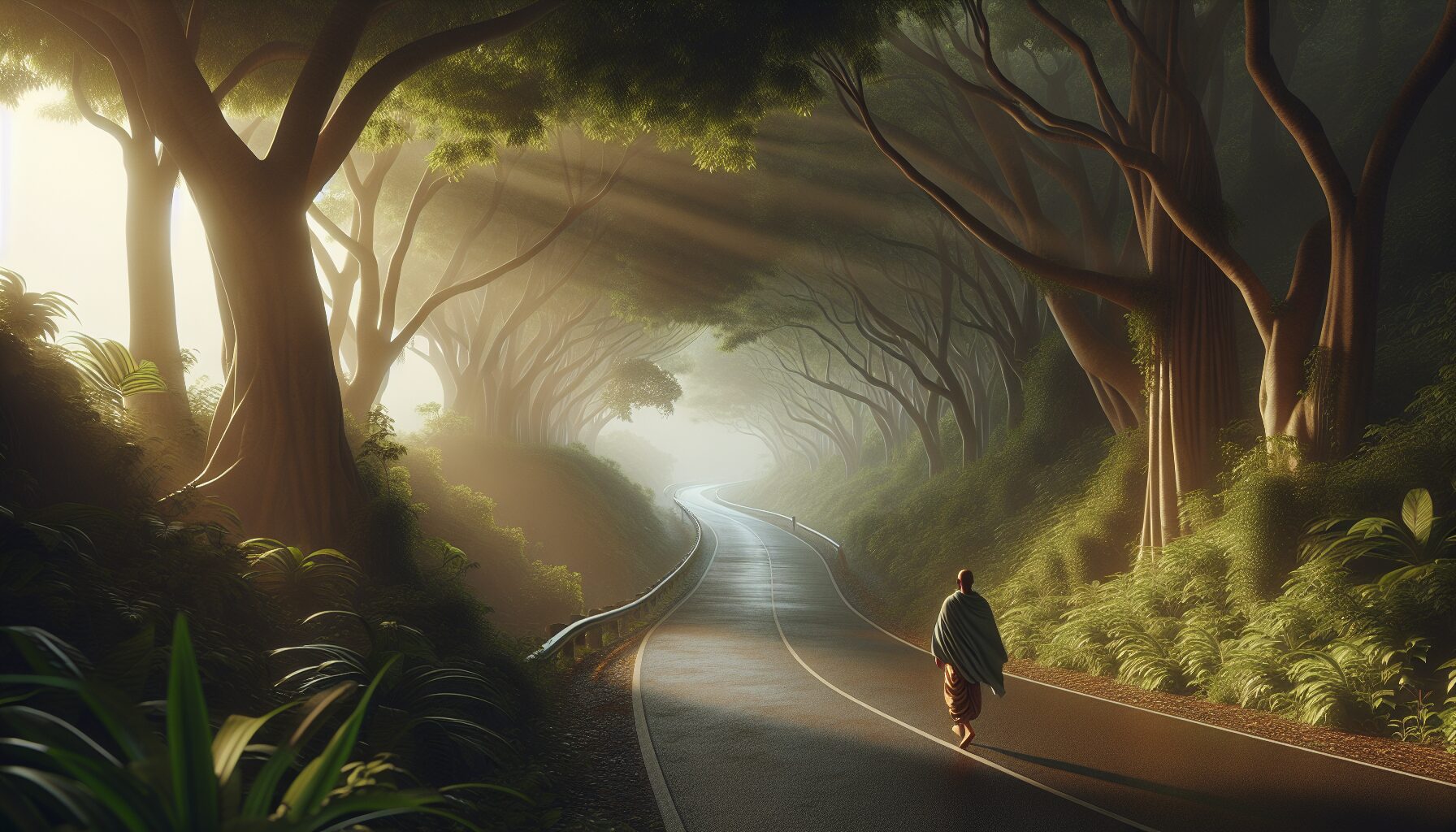
  • The Hermit’s Road — Solitude as Communion

    The Hermit’s Road — Solitude as Communion

    The Hermit’s Road — Solitude as Communion

    The Hermit’s Road — Solitude as Communion

    In a world that celebrates connectivity, the hermit’s path might seem like a solitary journey against the grain.
    Yet, for millennia, the figure of the hermit has fascinated and inspired people across cultures. The allure is rooted
    in the paradox of finding communion in solitude—a sacred engagement with the self, and perhaps, with something greater.

    “The monotony and solitude of a quiet life stimulates the creative mind.” — Albert Einstein

    The Historical Lure of Hermitism

    From the deserts of Egypt to the mountains of Tibet, hermits have pursued lives of solitude for different reasons:
    religious devotion, philosophical inquiry, or a simple rejection of societal norms. Despite diverse backgrounds,
    they share a common pursuit—a deeper understanding of life’s essence through isolation.

    • Desert Fathers: In the 3rd century, a group of Christian hermits retreated into the deserts
      of Egypt, seeking spiritual enlightenment away from the comforts and distractions of society.
    • Taoist Hermits: Taoist sages in ancient China often withdrew to remote mountains to refine their
      spiritual practices and connect with the fundamental rhythms of nature.
    • Tibetan Recluses: Tibetan Buddhism has a rich tradition of monastics and lay practitioners
      adopting solitary retreats to deepen their meditative practices.

    The Spiritual Dimension of Solitude

    Hermits step away from the communal aspects of religion to foster a personal bond with their beliefs. In this process,
    solitude serves not as an escape but as a space for profound spiritual introspection. As the Buddhist monk
    Thich Nhat Hanh noted, “The more you focus
    on your breathing, the more you encounter your body and its relationship with the earth.”

    Solitude becomes sacramental, transforming the isolated landscape into a canvas for communion with the divine. It
    allows for an inward pilgrimage, unearthing wisdom from within and attuning individuals to the silent voice of the cosmos.

    The Modern Implications of Solitary Practice

    Contemporary society often equates solitude with loneliness, a condition to be remedied rather than explored. However,
    many modern hermits and practitioners of solitude find that it offers a fertile ground for personal growth and wellbeing.

    “In the solitude of the wilderness, we find ourselves. And that is more than enough.” —
    John Muir

    • Introspection and Mental Clarity: Time spent alone can lead to greater self-awareness and insights,
      allowing the individual to reassess life’s priorities without external pressures.
    • Creative Inspiration: Solitude often breeds creativity, providing an unbroken focus that fuels
      novel ideas and innovations.
    • Emotional Resilience: The practice of facing one’s thoughts and emotions in solitude can lead
      to greater emotional stability and a more profound sense of personal autonomy.

    A Path Forward with Solitude

    As the world becomes increasingly connected, the concept of voluntary solitude challenges us to rethink our
    relationships with ourselves and the world around us. Embracing moments of silence and solitude, as brief or as
    extended as they may be, can be a powerful act of self-communion and emotional restoration.

    Whether one chooses to spend months in a secluded cabin or merely takes a solitary walk in a nearby park,
    the journey of the hermit underscores an essential truth: that in seeking solitude, we may find a richer communion
    with all of existence.

    The hermit’s road is not a path for everyone, but it offers profound insights into the human spirit’s capabilities
    when external noise is hushed. In the words of poet
    Walt Whitman
    , “I celebrate myself, and sing myself,” reminding us that solitude can be a profound form of
    celebration—a communion where one need not be alone to feel whole.

  • Crossing the Invisible Bridge — Between the Known and the Infinite

    Crossing the Invisible Bridge — Between the Known and the Infinite

    Crossing the Invisible Bridge — Between the Known and the Infinite

    The universe is not only stranger than we imagine, it is stranger than we can imagine. This oft-quoted insight by British astrophysicist Sir Arthur Eddington invites us to consider the vast chasm between our current understanding of existence and the infinite possibilities that lie beyond. The quest to bridge this gap is one of humanity’s most enduring and profound endeavors.

    The Known: Our Current Realities

    Today, science and philosophy have mapped numerous aspects of the universe, from the smallest particles that form matter to the largest cosmic structures. Our “known” universe is governed by laws described by physics, a language woven from the threads of empirical evidence and mathematical rigor.

    • Quantum Mechanics: This field examines the behaviors of particles at the smallest scales, revealing that at its core, reality may not function according to our traditional expectations.
    • General Relativity: Einstein’s groundbreaking theory reshaped our understanding of gravity and laid the foundation for exploring cosmic phenomena such as black holes and the expansion of the universe.

    “The important thing is not to stop questioning. Curiosity has its own reason for existing.” — Albert Einstein

    The Infinite: Beyond the Horizons

    Yet, beyond these tangible understandings rests the infinite—a realm of unanswered questions and untapped potentials. Concepts like multiverse theory, which suggests countless universes drift beyond our perceptual reach, challenge the boundaries of the known.

    In philosophy, existential inquiries into the nature of consciousness and free will intersect with these scientific paradigms, pushing the boundaries of our understanding even further. Could technologies, such as artificial intelligence and quantum computing, guide us across this “invisible bridge” to new realities?

    Bridging Realms: The Human Endeavor

    Humanity’s pursuit of the infinite is a testament to our unyielding curiosity and desire for deeper understanding. Great strides have been made, yet each discovery and theory often leads to new questions, perpetuating an eternal cycle of curiosity and pursuit.

    As we seek to cross the invisible bridge between the known and the infinite, we must embrace both scientific rigor and philosophical inquiry. In doing so, we not only expand our knowledge but also deepen our appreciation of the cosmos and our place within it.

    For further reading, consider exploring resources such as Stanford Encyclopedia of Philosophy or the latest papers from Physical Review Letters, which frequently publish cutting-edge research in these realms.

  • The Long Silence — What Pilgrimage Teaches About Time

    The Long Silence — What Pilgrimage Teaches About Time

    In our rapidly advancing world, where speed and efficiency are lauded above all else, taking the time to pause, reflect, and journey slowly through life is increasingly seen as a luxury. Yet, the ancient practice of pilgrimage offers profound lessons in understanding the nature of time. It is a journey that takes the pilgrim not just across physical landscapes, but through the corridors of their own mind, gifting them awareness of time in a way that modern life can seldom provide.

    The Essence of Pilgrimage

    A pilgrimage is no ordinary journey. Rooted deeply in spiritual and cultural traditions, it involves traveling to a place of significance over an extended period. This journey, often done on foot, strips life down to its essentials, requiring one to embrace a slower pace. The ancient Camino de Santiago in Spain, the Kumano Kodo in Japan, and the Hajj to Mecca are among the most revered pilgrimages around the world.

    “The pilgrimage was both an inner journey and an outer journey. I was carried forward by the desire to move, the need to come closer to myself.” – Debra Roberts, a modern pilgrim.

    • Disconnect to Connect: In stepping away from the clocks and calendars that govern our daily lives, pilgrims find a new rhythm dictated not by schedules, but by their own bodies and the earth beneath their feet.
    • The Power of Solitude: Solitude on the road becomes an ally. It offers a space for introspection, allowing a person to confront the ticking of the inner clock, often in ways they have never before faced.
    • Patience and Presence: The real lesson is patience. Pilgrims learn that some parts of their journey cannot be hurried. This patience fosters a new relationship with time, one that is more about presence than productivity.

    The Teachings of Time

    Time during a pilgrimage is cyclical and stretching. Each day starts with the rising sun, tasks repeated until they become a meditative ritual — walking, eating, resting. This repetitive time gives space for reflections, revelations, and resolutions, gradually uncovering why our ancestors revered the pilgrim path for its spiritual education.

    The Dewdrops of Daily Changes

    One of the most striking realizations for many pilgrims is how time itself becomes palpable. Pilgrims awake early and walk at dawn, noticing the subtle changes in the landscape which normally escape the notice of a hurried life. A soft breeze, the changing light, the different song of birds — all markers that time is alive and vibrant. This slower, more responsive interaction with time is therapeutic and transformational.

    The act of walking, of putting one foot in front of the other, teaches pilgrims the difference between clock time and experiential time. As Christian McEwen writes in “World Enough & Time: On Creativity and Slowing Down”, “As we pause to notice where we are, our sense of time shifts from speed to depth. We make time; we are made of time.”

    The Transformative Power of Ritual

    Much of modern life is about linear progression, but pilgrimage celebrates the cyclical nature of existence. Daily rituals along the pilgrimage path structure experience, teaching pilgrims to find joy in repetition and the small details of life. These lessons are often carried back into daily life, helping pilgrims maintain a sense of peace and clarity in a world that thrives on constant change.

    Returning to the Fast Lane

    When the journey concludes, pilgrims often face the challenge of integrating the slower, richer perceptions of time into their daily lives. This is no small feat, but those who succeed find that their transformation doesn’t end with the journey. Instead, they carry home a profound understanding of time’s elasticity — its power to heal, to reveal, and to connect.

    So what does pilgrimage teach about time? It teaches that time is not a commodity to be spent or saved. It is an ever-flowing river, an expansive sea of possibilities. Pilgrimage teaches us that while clocks measure time, only mindful presence can truly capture its essence. And perhaps, most importantly, it teaches us that every step taken in silent contemplation is a step towards eternity.

  • Footsteps on Sacred Earth — Honoring Every Step as Prayer

    Footsteps on Sacred Earth — Honoring Every Step as Prayer

    In a world often overwhelmed by noise and haste, the ritual of walking takes on a meditative quality and offers a way to reconnect with nature and self. This practice, which treats every step as an act of prayer, transforms the simple act of walking into a profound spiritual journey.

    The Spiritual Practice of Walking

    Walking is an ancient practice, as old as humanity itself. Yet, within many spiritual traditions, walking is also a sacred activity. For Buddhists, this is evidenced in the practice of kinhin, a form of walking meditation designed to bring presence and mindfulness with each step.

    “Walking is a form of meditation—with each step, we can naturally arrive in the present moment and touch the wonders of life available in that moment.” — BuddhaNet

    The act of treating every step as prayer acknowledges the sacredness of the Earth beneath our feet. This practice requires us to slow down, observing with gratitude and intent the world we sometimes rush through.

    A Journey of Mindfulness

    Mindful walking does not merely mean becoming aware of our steps but expanding this awareness to engage fully with our surroundings. As French philosopher Simone Weil wrote:

    “Attention is the rarest and purest form of generosity.” — Simone Weil

    Attention, in this context, is generous because it fills the present moment with wholeness, contemplation, and peace.

    • Breathing: Synchronize your breathing with your steps, allowing for a rhythmic, serene pace that aligns body and soul.
    • Observation: Notice the sounds, the feeling of the ground with each step, and the subtleties of nature that often pass us by.
    • Gratitude: Cultivate a sense of gratitude for the paths we walk and the life granted to us with each breath.

    The Influence of Landscapes

    Walking as a prayer connects us to the landscapes we traverse. Each environment imparts a different spiritual experience, be it the dense forests, the expanse of a desert, or the soothing rhythm of ocean waves.

    “I have walked myself into my best thoughts.” — Søren Kierkegaard, quoted on TED

    The essence of Kierkegaard’s sentiment reflects the dialogue between self and nature. In these spaces, one’s mind can wander freely, entering domains of inner reflection and coming to profound understandings.

    Footsteps in History

    The allegorical and literal journeys of legendary figures highlight the spiritual dimension of walking. Pilgrimages such as the Camino de Santiago in Spain define a physical and spiritual trail that has inspired countless individuals to reconnect with their deeper selves. Along this path, pilgrims often speak of experiencing a profound sense of connectedness and purpose.

    “To be a pilgrim is to become a carrier of all the human desires and experiences thousands of seekers have carried over the ages.” — Camino de Santiago

    These journeys demonstrate how walking, as an activity, merges the mundane with the sacred, bringing to light a tapestry of human experience interwoven with reflection and discovery.

    Honoring Every Step

    The notion that every step can be prayer invites us to honor both the individual and collective narratives found in our movements. This practice welcomes diverse beliefs and honors the Earth across cultures and traditions.

    • Native American Traditions: See walking as an act of integrating with the natural world, where each step links us back to the Earth.
    • Christian Pilgrimages: Use walking as a metaphor for the spiritual journey of life, a focused quest for faith.

    Therefore, honoring every step as prayer requires us to see our journey as a means of healing and understanding, inviting us to contemplate life’s mysteries with each movement.

    Conclusion

    Footsteps on this sacred Earth remind us to slow down and savor our surroundings, to listen to the world and to our souls. Through this practice, we learn that the Earth is not only beneath us but within us, and by treating each step as prayer, we walk toward a more mindful and compassionate existence.

  • The Journey Home — Rediscovering the Source Within

    The Journey Home — Rediscovering the Source Within

    The Journey Home: Rediscovering the Source Within

    In the fast-paced world of modern existence, the quest for meaning is often lost amid the tumult of daily responsibilities and fleeting distractions. Yet, the urge to connect with one’s inner source, an essence that promises true fulfillment, remains a persistent, age-old calling. The journey home—to rediscover the source within—is both an introspective exploration and a universal saga of human experience.

    The Longing for Home

    Throughout history, the metaphor of “home” has been juxtaposed with the idea of returning to one’s inner self. This intrinsic yearning is echoed in various philosophical and spiritual traditions, which propose that true contentment arises from understanding one’s origin and purpose.

    “The journey of a thousand miles begins with one step.” — Lao Tzu

    The notion of “home” transcends physical structures; it is a psychological and spiritual destination where individuals find harmony, wholeness, and a sense of belonging. In psychological terms, Carl Jung referred to this process as “individuation,” where one’s conscious and unconscious splice into harmony.

    Understanding the Inner Source

    • Definition: The inner source is an amalgam of intrinsic motivations, core beliefs, and inherent talents that define one’s identity.
    • Spiritual Perspective: Many spiritual paths describe this source as the soul or spirit, integral to comprehension of self beyond physical existence.
    • Scientific Insights: Neuroscience explores the brain’s role in self-awareness and introspection, identifying areas associated with the sense of self, such as the default mode network.

    To rediscover the source within means to unravel layers of social conditioning, inherited beliefs, and self-imposed limitations. This unfolding not only manifests authenticity but nurtures empathy, altruism, and a deeper connection to the cosmos.

    The Path to Rediscovery

    The journey to find one’s source is not a straightforward path but a labyrinthine venture filled with challenges and revelations. Here are pivotal steps in this transformative quest:

    • Introspection:
      Self-reflection is paramount. Journaling, meditation, and mindfulness practices help uncover hidden desires and fears.
    • Embracing Solitude:
      Thoreau’s famous retreat to Walden Pond exemplifies the power of solitude. In his words, “I never found the companion that was so companionable as solitude.”
    • Active Engagement:
      Integrate into the community. By engaging others, a reflection of one’s values and beliefs becomes evident. To quote John Donne, “No man is an island.”
    • Acceptance:
      Embrace imperfections. Recognizing and loving oneself fosters growth and inner peace.

    Navigating Through the Challenges

    The journey home can be fraught with challenges, both internal and external. Fear of the unknown, reluctance to confront painful truths, and societal pressures can hinder progress. Building resilience is crucial:

    • Mindfulness: Being present minimizes anxieties related to the past or future.
    • Support Systems: Form alliances with those who understand and support your journey.
    • Courage: The courage to act according to one’s values despite adversities.

    Carl Jung’s theories on the collective unconscious offer insights into overcoming these hurdles by accessing archetypes that guide personal growth.

    The Joy of Returning Home

    Rediscovering the source within often leads to profound joy and transformation. When individuals align with their inner core, they experience:

    • Purpose and Clarity: Clear understanding of life’s purpose and direction.
    • Inner Peace: A serene state where external chaos cannot easily perturb the mind.
    • Empowerment: By knowing oneself, individuals gain the power to transform their surroundings positively.

    Joseph Campbell, renowned for his work on the hero’s journey, encapsulates the essence of this endeavor: “The privilege of a lifetime is being who you are.”

    Continuing the Endless Voyage

    The journey does not end with a single revelation or moment of clarity. It is an ever-evolving journey that adapts and changes with life’s seasons. Reconnecting with the source within is a commitment to perpetual growth and an openness to continual learning.

    Consider reading more on Mindful Magazine, which discusses stories and exercises aimed at enriching the inner journey.

    Conclusion

    The journey home is an intimate odyssey that beckons one to peel back the veils obscuring true essence. In rediscovering the source within, individuals not only find their authentic selves but also kindle a light that can illuminate the world. This path, personal yet universally shared, promises a deeper connection to everything around us when traveled earnestly.

    The journey home teaches that the answers we seek outside often reside within. Through persistent exploration and heartfelt acceptance, we find that ‘home’ was never a destination but a state of being—inextricably woven with who we have been and who we strive to become.

  • Dust and Stars — Pilgrimage as a Mirror of Existence

    Dust and Stars — Pilgrimage as a Mirror of Existence

    From the ancient footpaths carved into the earth to the modern highways stretching across continents, pilgrimages have been an integral part of human history. They are journeys of spiritual significance, offering travelers a chance to explore the relationship between dust and stars — the mundane realities and transcendent aspirations of existence.

    The Essence of Pilgrimage

    Pilgrimage is more than a trek to a sacred site; it is a transformative inward journey that mirrors the broader human condition. The act of walking, often under physical duress, brings the traveler into the present moment. As writer Rebecca Solnit observes in her book “Wanderlust: A History of Walking”, “Walking… is how the body measures itself against the earth.”

    • Spiritual Reflection: Many believe that pilgrimage routes rest under the guidance of celestial paths, linking earthly pilgrimage with cosmic journeys.
    • Physical Endurance: The grueling nature of many pilgrimages, from the Camino de Santiago to the Hajj, epitomizes the endurance required to face life’s trials.

    The Historical Thread

    Historically, pilgrimages were not only expressions of faith but also opportunities for societal change and personal enlightenment. The importance of the journey lies in its uncertainty and ability to foster connections among diverse individuals.

    “The journey itself is my home.”
    — Japanese poet Matsuo Bashō

    Across cultures, from the Buddhist pilgrimages to Bodh Gaya to the Islamic pilgrimage of Hajj, the act reaffirms commitment to something greater than oneself. Each step challenges the pilgrim to relinquish the ego, abandoning material distractions for spiritual gain.

    Modern Pilgrimage: A Search for Meaning

    In the contemporary era, characterized by rapid technological advancements and globalization, pilgrimages have taken on new dimensions. Individuals embark on these journeys to detach from the chaos of modern life, seeking solace and purpose.

    • Rediscovery of Identity: Individuals walking the Camino de Santiago often describe their journey as a period of profound self-discovery.
    • Digital Detox: Many modern pilgrims turn to these paths as a form of digital detox, disconnecting from devices to reconnect with nature and themselves.

    Pilgrimage as a Mirror

    The parallel between a pilgrimage and human existence is poignant. Both are fraught with moments of joy, struggle, and revelations. The pilgrim becomes a microcosm of humanity’s eternal quest — a quest for meaning, understanding, and connection.

    Christian tradition holds pilgrimages, such as the journey to Jerusalem, as a metaphor for a believer’s journey towards heavenly union. The symbolism of pilgrimage as life encapsulates the trials and triumphs of moving through the world. As theologian Thomas á Kempis wrote in The Imitation of Christ, “This life is the way to eternal life.”

    Environmental and Cultural Preservation

    With growing environmental awareness, pilgrimages now also serve as catalysts for cultural and environmental preservation. Pilgrims mobilize resources to protect historical routes and sites against the encroachment of modern development.

    • Cultural Interactions: Routes like the Kumano Kodo in Japan showcase the blend of cultural heritage and natural beauty, inspiring conservation efforts.
    • Environmental Stewardship: Pilgrims often become advocates for protecting the landscapes traversed during their journeys.

    The Everlasting Journey

    Ultimately, pilgrimages reflect the perpetual cycle of life, encompassing beginnings, challenges, resolutions, and endings. As seekers chart their path across landscapes both familiar and foreign, they find that each step connects them to a larger tapestry of human thought and belief.

    In weaving through the worlds of dust and stars, the pilgrimage becomes a mirror where existence’s complexities are unraveled and embraced. As author Paulo Coelho notes in “The Pilgrimage”, “It’s the simple things in life that are the most extraordinary” — a truth revealed in the rhythm of each pilgrim’s footsteps.

  • The Temple Beyond Form — Seeking the Holy in the Everyday

    The Temple Beyond Form — Seeking the Holy in the Everyday

    The Temple Beyond Form: Seeking the Holy in the Everyday

    In a world dominated by sensory experiences, the idea of sacredness often seems confined to places adorned with elaborate architecture and profound historicity. Yet, as humanity transitions into an era that continually blurs the boundaries between the material and the spiritual, the quest for holiness in every ordinary moment becomes more pertinent. This shift encourages us to look beyond the tangible forms and embrace the sacred that permeates the everyday.

    Understanding the Temple Concept

    The notion of a temple traditionally evokes images of intricate edifices dedicated to divine worship, resilient through centuries of human endeavor. From the monumental pyramids of Egypt to the serene stillness of Shinto shrines in Japan, these sacred spaces symbolize humanity’s profound desire to connect with the higher realms. However, spiritual teachings across various cultures suggest that these structures serve as guides pointing towards an inner sanctum.

    “The temple is Holy because it is the focus of inner attention, not because of any structure.” – Alan Watts, philosopher and writer.

    In his works, Alan Watts emphasizes the importance of understanding sacredness not as a physical attribute, but as an inward journey. This view allows us to see temples beyond their physical existence, inviting us to reconceptualize what it means to encounter the holy.

    The Sacred in Daily Life

    Every moment holds potential for sacredness. The path to discovering the holy in the everyday begins with mindfulness—a practice that roots us in the present, awakening a deep sense of gratitude and reverence for each moment.

    • Mindful Awareness: Engaging with the present consciously can transform mundane activities into spiritual exercises. Whether it’s savoring the aroma of a morning coffee or feeling the ground beneath your feet during a walk, each moment becomes an opportunity for enhanced awareness.
    • Intentionality in Action: Approaching tasks with intention, regardless of their perceived significance, infuses them with meaning. As artist Agnes Martin suggested, “Art is the concrete representation of our most subtle feelings.” This sentiment can be applied to any form of creation, reminding us to acknowledge the divine in every act.

    Ritualizing the Ordinary

    Rituals need not be grandiose to be effective; small, personal ceremonies can profoundly alter our perception of everyday life, transforming it into a continuous sacred experience.

    • Morning Rituals: Starting the day with deliberate, peaceful activities can set the tone for a day filled with presence and purpose. This could be as simple as a moment of silent reflection or journaling.
    • Eco-Spirituality: Engaging with nature through gardening or conservation efforts can become a form of worship, recognizing the holy presence in the natural world. Poet Mary Oliver famously observed, “Attention is the beginning of devotion,” imploring us to offer our attention to the wonders around us as a spiritual practice.

    Challenges and Opportunities

    Seeking the sacred in the everyday is not without its challenges. The distractions of modern life often pull us away from recognizing the holy in our immediate experiences. Technology, while a tool of connection, can also serve as a barrier, dulling our senses to the profound simplicity of life.

    However, these challenges present unique opportunities for growth:

    • Digital Detox: Periodically disconnecting from digital devices can foster a deeper connection to the present moment and the world around us.
    • Learning from Indigenous Cultures: Many indigenous traditions maintain a profound respect for the sacredness of life. Their practices and philosophies can provide valuable insights into living a life of holiness.

    Renowned mythologist Joseph Campbell once said, “Your sacred space is where you can find yourself over and over again.” This pursuit of reconnecting with our true selves in the temple of the everyday world is an evolving path, requiring patience and perseverance.

    The Future of Everyday Sacredness

    The future of our spiritual practices lies in the harmony between the past and the present, drawing from timeless traditions while embracing contemporary innovations. As our understanding of the holy evolves, so too does our ability to recognize and create spaces of sacredness in the unlikeliest places.

    Smart cities, with their blend of technology and human-centric design, embody the concept of the modern temple, facilitating spiritual connections through intelligent environments that respond to human well-being.

    In conclusion, the pursuit of finding the holy in the everyday is a journey towards a deeper connection with ourselves and the universe. This divine search, inspired by both ancient wisdom and modern insight, encourages us to transform every moment into a touchpoint of the sacred. By cultivating awareness and gratitude, we begin to dismantle the illusory barriers between the sacred and the mundane, revealing the temple beyond form.

    As we continue this journey, let us remain open to the possibility that the most profound spiritual experiences can occur in the simplest of actions, inviting the holy into our daily lives and awakening a deep, endless reverence for the world.

    Further reading and ideas are inspired by Brain Pickings and other spiritual literature sources.

  • Mountains of the Mind — Inner Ascents and Hidden Valleys

    Mountains of the Mind — Inner Ascents and Hidden Valleys

    The concept of mountaineering has long captivated the human imagination, not just as a physical conquest but as a profound metaphor for our inner journeys. As we scale the peaks of our personal challenges or navigate the hidden valleys of introspection, we engage in a dance as old as humanity itself. In Mountains of the Mind, Robert Macfarlane explores this allegory, beautifully weaving together the threads of landscape and thought.

    “The mountains we climb are not made only of rock and ice, but also of dreams and desire,” writes Macfarlane, capturing the essence of why humans are drawn to the highest places on Earth.

    Macfarlane’s exploration reveals how mountains reflect our desires, fears, and aspirations. Through his narrative, he offers a profound insight into the mental landscapes that mimic physical geography. Here are a few key contemplations for those embarking on their own mental climbs:

    • Facing Fears: Just as climbers face avalanches and sheer drops, we must confront our inner fears. Acknowledge their presence and understand that fear itself is not the foe but the path to courage.
    • Finding Solitude: Like the secluded valleys nestled between peaks, moments of solitude provide the space for introspection and personal growth. Embrace these pauses as opportunities to reflect and renew.
    • Endurance and Patience: Every summit requires endurance; so do journeys of the mind. As Macfarlane notes, “Mountaineering is a slow and deliberate progress towards a distant goal,” much like overcoming personal obstacles.
    • Connection to Nature: Climbing brings us closer to the raw beauty of the natural world, grounding us and reminding us of our place within it. This connection fosters humility and gratitude.

    Macfarlane deftly illustrates that the mountains of our mind are as real as those that carve our planet’s surface. The act of climbing is both an outward and inward journey, just as likely to take us to a place of self-discovery as to a physical peak. His work suggests that the true summit lies within us—an idea echoed by many explorers and writers before him.

    For more on this entwined concept of self and landscape, explore Robert Macfarlane’s work on Amazon.

    Ultimately, Mountains of the Mind invites us to consider our own ascents and descents, understanding that every peak we conquer shapes who we are and the landscapes of life we traverse.